
Packback Peer Review
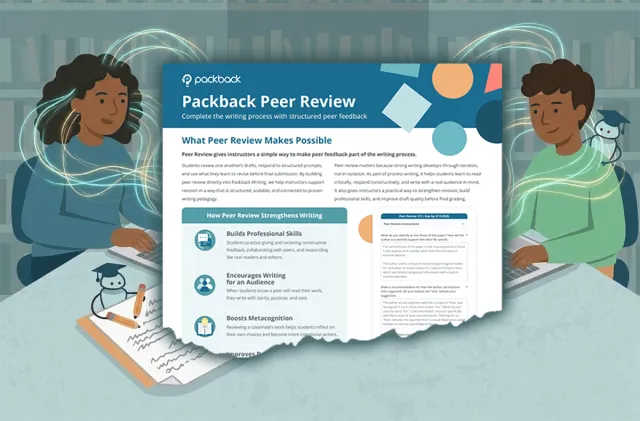
Download the Peer Review datasheet to learn more about this pedagogy-first tool powered by Instructional AI that assists with moderation and matching while the core feedback remains a human-to-human exchange between students.
Peer Review Works for Everyone

- Show Administrators how structured feedback at scale is a proven driver of retention through student satisfaction and grade outcomes.
- See how Faculty get scalability & peace of mind with automatic student matching and completion-based grading. Plus, when students know a peer is reading, they write with more clarity and care.
- How Students can reflect on their own choices and become more intentional, critical writers while practicing workforce skills by collaborating and responding like real-world readers and editors.
- Give IT Teams peace of mind knowing Packback Peer Review is built on existing rails with low-friction LMS integration (Canvas, Blackboard, etc.) and SSO.
Most peer review feels like busywork for students and a logistical nightmare for you. We’ve turned it into a structured, scalable engine for revision that actually improves final submissions before you even start grading.
What are the benefits of peer review in the writing process?
Integrating peer review into the writing process offers three distinct advantages for both student outcomes and institutional goals:
- Improved Final Submissions: Peer review catches errors and logic gaps early. This results in higher-quality final drafts, which reduces the “heavy lifting” and time spent by faculty during the final grading phase.
- Metacognition: Reviewing a classmate’s work helps students reflect on their own writing choices, making them more intentional authors.
- Audience Awareness: Students write with greater clarity and care when they know a peer, not an algorithm, will read their work.
How to make peer review scalable in large classes?
Scaling peer review in high-enrollment courses traditionally fails due to the “manual matching” bottleneck. Packback Peer Review makes this process scalable by utilizing automated student matching. Instead of instructors managing spreadsheets, the platform automatically pairs students and tracks completion. This allows faculty to implement a rigorous “Draft → Feedback → Revision” cycle in a 300-seat lecture as easily as a 15-student seminar.
What are the best tools for structured peer feedback?
The best tools for structured peer feedback go beyond a simple “comment box.” Packback provides students with guided feedback prompts that scaffold the review process. By requiring students to identify specific elements, like a thesis statement or a supporting evidence gap, the software ensures that feedback is consistent, actionable, and aligned with the instructor’s rubric. This eliminates “surface-level” comments and forces students to engage in higher-order thinking.
Ready to see how Peer Review fits your curriculum?
Download the one-pager to see the full list of features, pedagogical benefits, and a preview of the structured review instructions.