

How to Make Student Thinking Visible
Stop trying to catch AI. Learn how to design assignments that track the authentic learning process and move students from cognitive surrender to cognitive vigilance.
What You Will Find Inside the Field Guide
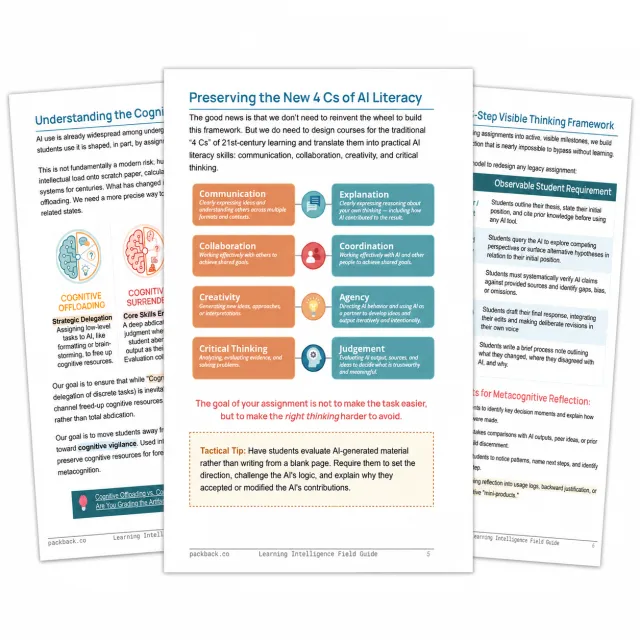
We know you don’t have time to reinvent the wheel. That is why this guide is packed with research-grounded, classroom-ready frameworks to build structural friction that is nearly impossible for a student to bypass without actually learning.
What’s Inside
- The 5-Step Visible Thinking Framework: A concrete model to redesign any legacy assignment, breaking it down into observable milestones: Anchor/Intent, Guided Inquiry, Active Critique, Revision & Voice, and Metacognitive Reflection.
- AI-Integrated Assignment Blueprints: Four ready-to-use assignment patterns that treat AI output as material to question and test, keeping students in the driver’s seat.
- Re-Engineered Rubrics: Learn how to stop asking performative “why” questions and start asking concrete, process-oriented “what” and “how” questions (e.g., “What logical gap did you spot in the AI’s reasoning?”).
- Turnkey LMS Prompts: Drop-in assignment templates built on the C.T.C.E. (Context, Task, Constraints, Ethics) structure, alongside a clear, student-facing syllabus handout.
The Grading Game Has Changed (And That’s Actually Good News)
For a long time, we relied on the final product as proof that a student understood the assignment. We graded the essay, the discussion post, or the completed code. But now that GenAI has entered the field, the final polished artifact is no longer a reliable receipt of learning.
The immediate reaction across education was to ban these tools or build massive walls of digital surveillance. You’ve likely felt the exhaustion of this approach: playing AI detective damages classroom trust, and the statistical tools used for AI detection remain notoriously unreliable.
But here is the good news: Pedagogy persists. We don’t need a better way to catch students; we just need a better way to make their thinking visible. When we only look at what a student turns in, we miss the struggle, the false starts, and the real breakthroughs that define true education.
Your Guide to the Post-Detection Era
This practical field guide was created to help you shift your course design away from a mindset of policing and toward process and co-creation. If we only grade the view at the top of the mountain, we invite students to take a helicopter to the summit. Instead, we must measure the climb.
By downloading this guide, you will learn how to confidently navigate the cognitive spectrum, distinguishing between:
- Cognitive Offloading: The strategic delegation of low-level tasks (like formatting or brainstorming) to AI, freeing up resources for deeper work.
- Cognitive Surrender: A deep abdication of judgment where a student adopts AI output as their own, causing critical evaluation to collapse.
- Cognitive Vigilance: The ultimate design goal, where students actively query, verify, and revise AI outputs rather than accepting them blindly.
Make the Right Thinking Harder to Avoid
Your goal as an educator isn’t to make tasks easier, but to make the right thinking harder to avoid. By shifting the grade weight to the process, you make authentic learning significantly more valuable than a polished, AI-generated essay.