Stop Guessing Why Students Struggle: How to Make the Invisible Writing Process Visible
Share this Article

In the age of instant content generation, your LMS inbox is filled with submissions that are technically correct, but functionally empty. They read well, they pass basic checks, but they offer you no insight into the actual learning that took place. This blog provides strategies on how to get students to actually engage with course content.
The New Reality in Writing Instruction
Ask any educator today: The final essay is no longer the full story.
In the age of instant content generation, your LMS inbox is filled with submissions that are technically correct, but functionally empty. They read well, they pass basic checks, but they offer you no insight into the actual learning that took place.
You’re left with a question that defines the modern classroom: How can I give meaningful feedback when I can’t tell if the student’s thinking process was their own?
If the student is the hero, Generative AI has become the sidekick that is making them cognitively offload the adventure. And the instructor is left to police the final product, instead of guiding the process. Today, we are thrilled to announce Engagement Insights, a powerful new feature set within Packback Writing. It is our answer to this crisis of authenticity, trust, and invisible effort. Engagement Insights is not another detection tool; it is a writing process tool for formative assessment that helps you restore the integrity of the academic essay by making the invisible visible.
Why Making Student Thinking Visible is No Longer Optional
For years, Packback has championed metacognition strategies for student writing(the student’s ability to think about their own thinking). Our belief is that genuine learning happens when students reflect, revise, and grapple with complex ideas.
But with one-click tools that enable “cognitive offloading,” the writing process, which is the core of learning, has been reduced to a single submission file. This has created three critical problems for educators:
- Eroded Trust: Grading becomes an exercise in suspicion, not instruction.
- Ineffective Feedback: Without knowing where a student struggled (outlining? revising? reflection?), feedback is generic and low-impact.
- The Black Box of Effort: You can see the result, but you cannot assess the effort. We know that effort and time spent in the drafting stages correlate directly with better outcomes, but this data was trapped inside the student’s head or on their private hard drive.
We built Engagement Insights to dismantle this black box. We shift the focus from a punitive “Did they cheat?” mindset to a pedagogical “How did they learn?” framework. This is the difference between a tool that detects and a tool that acts as a guide.
How Engagement Insights Captures the Authentic Writing Process
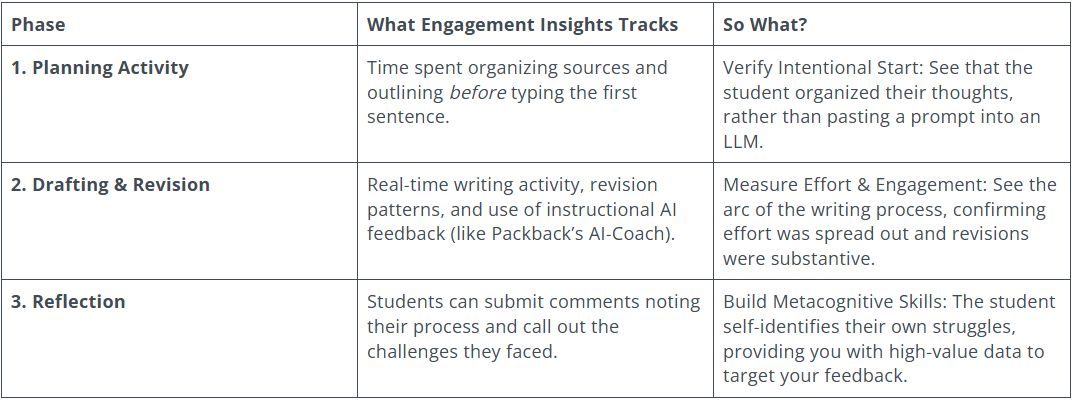
Engagement Insights is built on an educational research foundation of metacognition and self-regulated learning. It transparently tracks key behavioral signals across the three core phases of the Packback Writing assignment lifecycle: Plan, Draft, and Reflect.
The Three Phases of Authenticity
Introducing the Writing Process Report
The culmination of this data in Packback Writing is the Writing Process Report. This is your transparent, comprehensive view of a student’s engagement across the entire assignment. It offers the clarity you need to move beyond suspicion and toward targeted intervention.
Targeted, Process-Oriented Feedback in Action
This is where the real value comes alive. Engagement Insights fundamentally changes your day-to-day workflow and amplifies your impact.
1. Transform Your Feedback Loop
Instead of writing broad feedback like “Unclear argument,” you can look at the Writing Process Report and say, “I see you spent 80% of your time in the Drafting phase and very little time Planning. Your argument is unclear because you started writing before you settled on a thesis. Let’s work on outlining.”
- The Outcome: Your feedback becomes instantly more specific, actionable, and tied directly to the student’s behavior and skill deficit.
2. Identify At-Risk Students Instantly
The Writing Process Report provides a clean data point on student effort. You can see the students who spent minimal time drafting, showed no revision patterns, or skipped the planning phase entirely.
- The Outcome: You can trigger early, targeted intervention like an email or check-in before the student receives a final grade, making instruction truly formative.
3. Foster Trust and Ownership
By making the process transparent, you create a trust-based learning environment. Students are encouraged to comment on their process and own their work because they know their authentic effort will be visible and rewarded. This is the only sustainable way to promote academic integrity without adding administrative burden.
- The Outcome: You spend less time policing the final product and more time doing what you love: teaching.
The Essay is Not Dead. It’s Just Invisible.
The academic essay is not dead; it is merely invisible inside the generative black box.
With the launch of Packback Engagement Insights, we are giving the educator the power to see inside that box, reclaiming the value of the student’s thinking process. This is the next evolution of process-oriented feedback, offering a clear, data-driven path to better learning outcomes, deeper student confidence, and restored trust in the classroom.
Ready to see how making thinking visible can transform your writing assignments?