5 Ways to Action Writing Process Data
Share this Article

In our recent webinar, Reclaiming Engagement: Tracking Student Process, Planning, and Authenticity in the Age of AI, we introduced Engagement Insights and shared why process data matters now more than ever. The question now is what is process data and how do you use it?
Turning Engagement Insights into Better Feedback, Stronger Writing, and Smarter Interventions
In our recent webinar, Reclaiming Engagement: Tracking Student Process, Planning, and Authenticity in the Age of AI, we introduced Engagement Insights and shared why process data matters now more than ever.
For years, most writing assignments have been evaluated based on a finished product. But as we discussed in the session, grades reflect outcomes. Engagement reflects process. And the process is where learning actually happens.
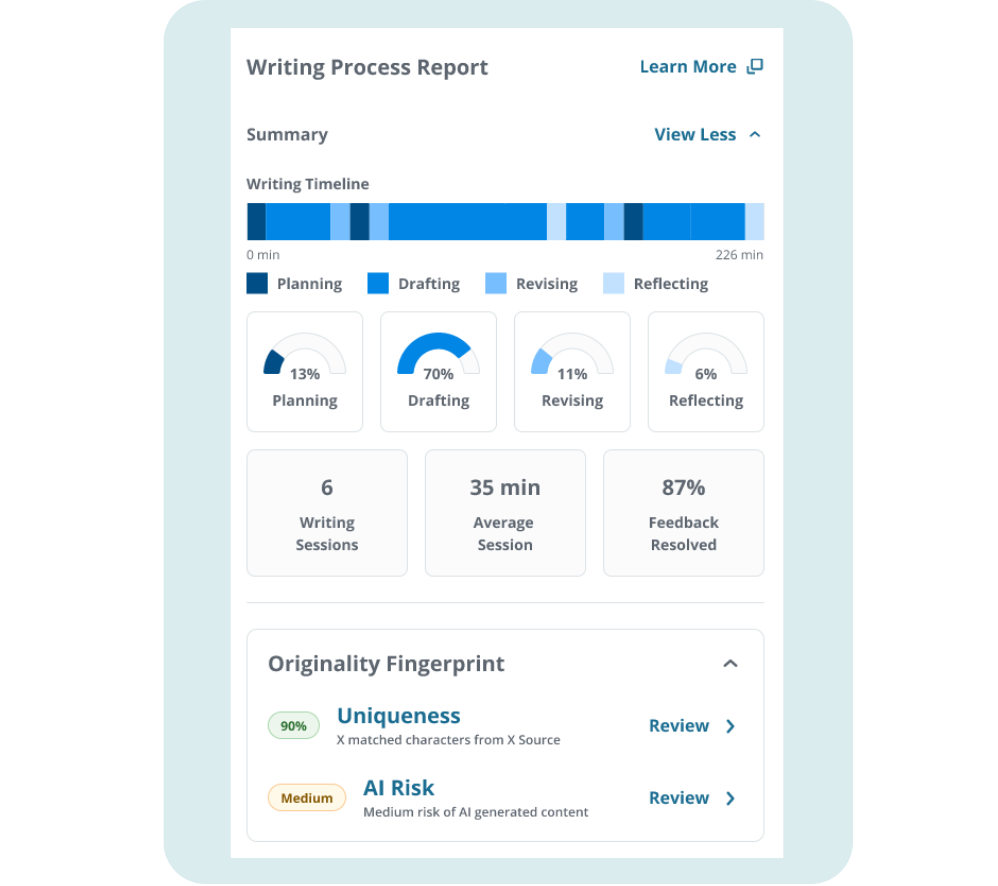
Engagement Insights makes the invisible visible. You can now see how students plan, draft, reflect, and revise. Even more importantly, students can annotate their own thinking to provide context around their decisions.
The question now is not what is process data? It’s how do you use it?
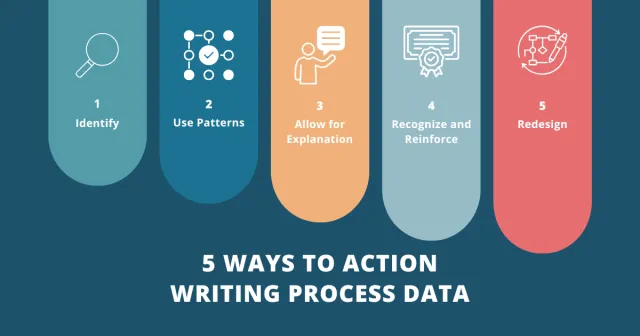
Below are five practical ways to turn Engagement Insights into action in your course.
1. Identify Where Students Are Getting Stuck
Every final paper hides a story. Some students outline extensively but struggle to translate ideas into prose. Others draft quickly and submit with minimal revision. Some revise only in the final hour before a deadline.
Engagement Insights allows you to see where the friction is actually occurring. Are students spending time planning but not drafting? Are they drafting but skipping reflection? Is revision shallow or iterative?
These signals help you differentiate between a conceptual issue and a process issue. A weak argument may not stem from misunderstanding the material. It may stem from insufficient revision. A disorganized paper may reflect rushed drafting rather than lack of comprehension.
Instead of responding only to what appears on the page, you can tailor feedback to the stage where learning broke down.
For example:
- If a student drafts thoroughly but rarely revises, your feedback can emphasize revision strategy and self-review practices.
- If a student spends significant time planning but struggles to begin drafting, you might provide structural scaffolding such as paragraph starters or thesis refinement exercises.
Process data moves feedback upstream. It allows you to coach the habit, not just critique the outcome
2. Use Process Patterns as Early Intervention Signals
One of the central ideas we discussed is that engagement is a strong predictor of student persistence and achievement. The challenge has always been visibility. Historically, disengagement only becomes obvious when a student stops submitting work or earns a low grade.
By that point, the damage is already done.
Engagement Insights surfaces disengagement earlier and in more nuanced ways. A student who drafts significantly less over time. A student who skips reflection stages repeatedly. A student whose revision depth steadily declines. These are subtle signals, but they are meaningful.
When you notice these patterns, you have an opportunity to intervene before performance collapses. A short, targeted message referencing observable process behavior can feel far more supportive than a generic check-in. For instance, “I noticed you didn’t revise much on this draft compared to your previous assignment. How are you approaching revision?” invites reflection without accusation.
In large lecture courses especially, where silent disengagement is common, this kind of visibility allows you to prioritize outreach strategically rather than reactively.
3. Let Students Explain Their Thinking in Context
One of the most underappreciated elements of Engagement Insights is student commentary. Students can annotate their own work to explain decisions, clarify uncertainty, or ask for feedback in specific areas.
Faculty often have to reverse-engineer intent. Was that broad thesis an intentional choice or a drafting shortcut? Did the student misunderstand the assignment, or were they experimenting with scope? Without context, it’s easy to misinterpret both effort and ability.
When students leave commentary such as, “I’m not sure if this counterargument is fully developed,” or “I struggled narrowing my topic here,” they are inviting targeted feedback. They are also practicing metacognition and articulating how they think about their own work.
Reading commentary before reviewing the draft changes your lens. It shifts you from evaluator to collaborator. Instead of guessing at the root issue, you respond directly to the student’s self-identified challenge.
Over time, this builds a culture where writing is not a silent transaction but an ongoing conversation.
4. Recognize and Reinforce Effective Process Habits
In traditional grading models, two students can receive similar marks for very different learning behaviors. One may produce strong work quickly with little revision. Another may iterate meaningfully, revise deeply, and demonstrate visible growth.
When only the final product is evaluated, those differences collapse.
Process visibility allows you to reinforce behaviors that drive long-term development: sustained revision across sessions, thoughtful planning before drafting, reflective engagement with feedback, iterative refinement of claims.
We are not trying to reward effort for effort’s sake, but instead trying to help students build good habits and establish a process. When you explicitly acknowledge productive habits like “I can see how your argument evolved across revisions” or “Your reflection shows you’re thinking critically about your structure”, you validate growth as part of academic rigor.
Students begin to understand that revision is not remediation and that when an effective process is named and recognized, they are more likely to repeat it.
5. Redesign Assignments Based on Real Process Data
Perhaps the most strategic use of Engagement Insights is at the course level. When you aggregate patterns across students, you gain insight not just into individual behavior, but into how your assignments are functioning.
You may notice that most students skip reflection prompts entirely. Or that planning time is consistently minimal before complex analytical essays. Or that revision clusters within the final 24 hours before submission across the majority of the class.
Those patterns are not just student shortcomings. They are instructional signals.
If reflection is routinely bypassed, you might restructure the assignment to make reflection a graded checkpoint rather than an optional add-on. If revision consistently happens at the last minute, you might introduce staged deadlines for draft components. If planning is thin before high-stakes essays, you might integrate structured outlining exercises into class time.
Rather than relying on intuition about what students “should” be doing, you can respond to evidence of what they are actually doing.
That level of alignment between instructional design and student behavior is difficult to achieve without process visibility.
Bringing Process Back to the Center of Writing Instruction
For years, higher education has evaluated writing as a static product. At the same time, we’ve talked extensively about growth, iteration, and critical thinking. There has been a disconnect between what we say we value and what we measure.
In the webinar, we described how institutions have historically relied on the wrong signals. Engagement Insights is a step toward correcting that imbalance. It illuminates thinking in motion.
For faculty, that means:
- Earlier and more precise interventions
- Feedback that addresses habits, not just outcomes
- Greater clarity into student effort and development
- More informed assignment design decisions
For students, it means greater transparency and ownership. They can explain their reasoning. They can ask for feedback in context. They can see revision as integral to learning rather than as an afterthought.
The final paper still matters. But when you can see how it came together, you are no longer grading a snapshot. You are teaching the process.
Recent Articles
-
Introducing Packback’s ROI Calculator: See the Financial Impact of Student Retention
-
The Calculus of the Shortcut: Lessons from a Conversation with a College Junior
-
Webinar Recap: Supporting Original Thinking: Making AI a Partner in Learning
-
Webinar Recap – Reclaiming Engagement: Tracking Student Process, Planning, and Authenticity in the Age of AI