Webinar Recap: Supporting Original Thinking: Making AI a Partner in Learning
Share this Article


This webinar recap covers how to distinguish between AI that replaces cognitive effort and AI that scaffolds it, and why community colleges are leading the way on responsible instructional design.
Artificial intelligence is reshaping how students write, research, and learn. But the deeper question facing educators is how to preserve and strengthen original thinking in a world where generative tools are readily available.
In Episode 4 of our Human-Centered AI Webinar Series, hosted by Craig Booth, Barbara Kenny, and Cynthia Wilson from the League for Innovation in the Community College, we explored what it means to make AI a partner in learning rather than a substitute for thinking.If you missed the live session, you can access the full on-demand recording, transcript, and slide deck here. What follows is a recap of the key ideas that resonated most strongly with faculty and administrators in attendance.
The Core Tension: How Do We Protect Thinking Without Rejecting Technology?
At the center of this session was a question many institutions are quietly grappling with: How do we preserve original thinking when generative AI is already woven into students’ academic lives?
AI is not an external disruption anymore. It is part of the learning ecosystem. Students can generate drafts, summaries, and responses in seconds. That reality forces a deeper examination of what we are actually asking students to develop.
If learning becomes defined by the quality of the final product alone, AI fits neatly into that equation. It can help produce polished work efficiently. But higher education has never been solely about producing polished work. It is about building the habits of mind that lead to analysis, synthesis, revision, and independent judgment.
The tension, then, is not between embracing technology and rejecting it. It is between preserving the cognitive process and allowing that process to be compressed. If generative AI accelerates output, institutions must decide how they will continue to protect the slower, iterative stages of thinking that cultivate real intellectual growth.
That distinction shaped the conversation and framed the challenge of whether course design, feedback structures, and institutional norms still prioritize the work of thinking itself.
What the Polls Revealed About Student Perceptions of AI
Early in the session, we asked attendees how they believe students perceive generative AI in relation to their education.
The responses sparked an honest and nuanced discussion.
Many educators shared that students see AI as a productivity tool. Something that helps them move faster. Something that reduces friction. Something that makes academic work more efficient.
That perception is not inherently negative. Students are operating in a high-pressure environment. Many are balancing jobs, caregiving responsibilities, and full course loads. Efficiency feels rational.
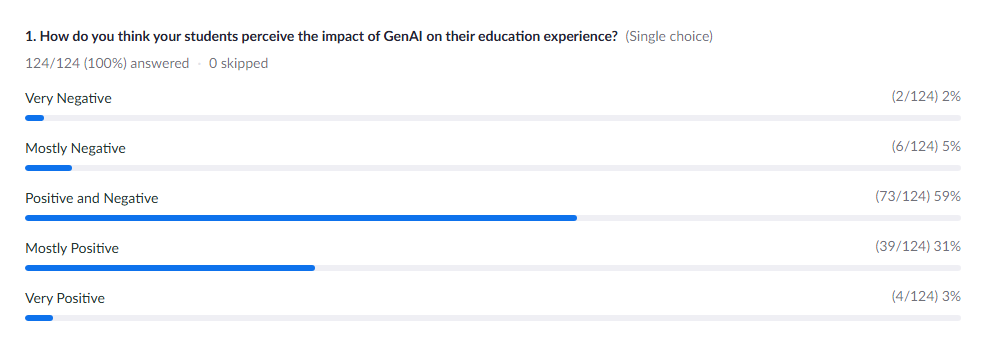
But the deeper question surfaced quickly: If students primarily view AI as a way to accelerate output, what does that mean for cognitive development?
When AI is framed as a shortcut, it reshapes expectations. Learning becomes something to optimize rather than something to wrestle with. The struggle, the confusion, the false starts that characterize real intellectual growth begin to feel unnecessary.
Reframing the Conversation: From Generative AI to Instructional AI
One of the most important shifts in the webinar was moving from a focus on generative AI to a focus on Instructional AI.
Generative AI produces outputs. It can draft essays, summarize readings, and answer questions. When used without guardrails, it can become a shortcut.
Instructional AI, by contrast, is designed to tutor. It provides structured feedback while students are writing. It prompts deeper analysis. It surfaces gaps in reasoning. It strengthens clarity and evidence use. Crucially, it does not replace the student’s cognitive effort.
When AI is aligned with frameworks such as Bloom’s Taxonomy and mastery learning, it can push students toward higher-order thinking rather than enabling surface-level completion. The goal is not efficiency for its own sake. The goal is intellectual growth.
That framing resonated strongly with the community college leaders in attendance, many of whom serve students balancing multiple responsibilities and varied academic preparation levels. Immediate, formative feedback can function as scaffolding rather than substitution.
Supporting Original Thinking by Design
Original thinking does not emerge simply because assignments require essays. It develops when students receive:
- Timely, formative feedback
- Clear expectations about analysis and evidence
- Opportunities to revise and deepen their ideas
- Reinforcement for curiosity and inquiry
AI can either erode or strengthen this process depending on how it is implemented. If it generates finished work, it narrows learning. If it provides structured coaching during the drafting process, it can expand it.
For administrators, this is not just a classroom concern. It connects directly to institutional priorities such as retention, engagement, and equitable outcomes. Students who receive immediate feedback and clarity on how to improve are more likely to persist and build confidence in their academic abilities.
For faculty, it addresses another pressing issue: time. When formative feedback is embedded earlier in the writing process, instructors can focus their energy on higher-level intellectual engagement rather than repetitive surface corrections.
Why Community Colleges Are Leading This Conversation
Partnering with the League for Innovation in the Community College underscored an important truth:Community colleges are often at the forefront of pedagogical innovation because they must be.
They serve diverse learners, first-generation students, returning adults, and working professionals. In this context, access to immediate, personalized feedback can be transformative. But only if it reinforces agency.
The future of ethical AI in higher education will not be defined by prohibition or uncritical adoption, but by thoughtful integration grounded in pedagogy.
Institutions that succeed will not ask, “How do we control AI?” They will ask, “How do we design learning environments where AI strengthens curiosity, rigor, and student ownership?”
Recent Articles
-
Introducing Packback’s ROI Calculator: See the Financial Impact of Student Retention
-
The Calculus of the Shortcut: Lessons from a Conversation with a College Junior
-
5 Ways to Action Writing Process Data
-
Webinar Recap – Reclaiming Engagement: Tracking Student Process, Planning, and Authenticity in the Age of AI