Mapping Essential Skills to
AI Literacy Competencies
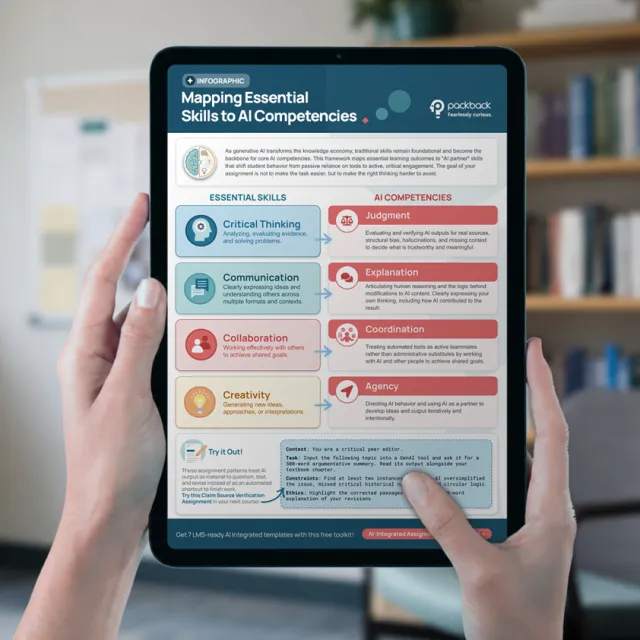
See how foundational learning outcomes translate into practical AI competencies. Help your students develop critical thinking, communication, collaboration, and creativity in the age of AI!

Critical Thinking
Analyzing, evaluating evidence, and solving problems.

Judgment
Evaluating and verifying AI outputs for real sources, structural bias, hallucinations, and missing context.

Communication
Clearly expressing ideas and understanding others across formats and contexts.

Explanation
Articulating human reasoning and the logic behind modifications to AI-generated content.

Collaboration
Working effectively with others to achieve shared goals.

Coordination
Working with AI as an active teammate rather than using it simply to automate tasks.

Creativity
Generating new ideas, approaches, or interpretations.

Agency
Directing AI behavior and developing ideas and outputs iteratively and intentionally.
The skill stays. The evidence changes.
Strong AI literacy is not demonstrated by accepting a polished answer. It becomes visible when students assess, explain, coordinate, and choose what happens next.
Try it out: Claim-Source Verification
A ready-to-adapt assignment that moves students from accepting AI output to evaluating it.
Generative AI can produce convincing arguments, but convincing does not always mean accurate. In this assignment, you will act as a critical editor. You will compare an AI-generated explanation with your course reading, identify what the AI missed or got wrong, and defend your corrections with evidence. The goal is to practice your own judgment, not simply improve the AI’s writing.
You are a critical peer editor reviewing a draft produced by generative AI.
Ask a generative AI tool to write a 500-word argumentative summary of [assigned topic]. Read its response alongside [assigned course reading or textbook chapter].
Identify at least two places where the AI oversimplifies the issue, misses important nuance or context, uses circular reasoning, or makes a claim that the course reading does not support. For each, cite a specific passage or piece of evidence from your reading.
Highlight the passages you would correct and write a 100-word explanation of what you changed, which evidence guided your decisions, and why those corrections matter.
Turn in the AI-generated summary with your highlighted corrections, your supporting evidence, and your 100-word explanation. Your work will be evaluated on the quality of your evidence and reasoning, not on whether you found every possible AI error.
For instructors: Replace the two bracketed fields with your topic and assigned reading before sharing with students.
Learn More About Building AI Literacy In Your Courses

AI Integrated Assignments Toolkit
This comprehensive toolkit shifts the student’s role from a passive content generator to an active senior editor. Everything in this toolkit is designed for immediate impact and extreme simplicity.