Why Trying to ‘Catch’ AI Use is a Losing Game for Higher Education
Share this Article


Relying on AI detection for teachers damages trust and yields false positives. The real solution is grading the learning process, not just policing the final output.
It’s Saturday night, and you are staring at a 63% AI-likelihood score on a student’s essay. The dread sets in.
Do you send the confrontation email?
Do you ignore it?
What if it’s a false positive?
If you are relying on ai detection for educators, you are already familiar with this lose-lose scenario. The technology is changing faster than most policies can keep up. Generative AI changes the conditions under which students write, study, research, and participate.
Trying to catch every instance of AI use is exhausting for everyone, and frankly, it’s the wrong battle. The challenge now is designing learning environments that still protect what students need to practice: judgment, reflection, revision, and original thought.
Here is exactly why the policing approach is failing students and educators alike, and how higher education can pivot to a strategy that actually protects original thought.
Why Are AI Detectors Inaccurate and Problematic for Educators?
AI detectors are fundamentally fragile. They look for predictable word patterns, which means they routinely flag neurodivergent students, non-native English speakers, and students who just write with straightforward syntax. The emotional toll of this false-positive epidemic is severe, and for the institution, it breeds uncertainty and suspicion. With a growing number of students facing false accusations, the adversarial dynamic destroys the classroom environment.
Detection-first approaches may address a narrow integrity concern, but they can also place faculty in the role of Al police and make students feel watched instead of guided.
When students feel surveilled rather than supported, it erodes trust.
We have created an environment where the burden of proof is entirely misaligned. AI creates a real problem when grading is judged mostly by the finished product. A polished response no longer tells us very much about how the student got there.
What are the Pros and Cons of AI in Higher Education?
First, not all AI is the same. One of the biggest mistake educators make is using “Generative AI” and “AI” interchangeably. Why does this distinction matter?
You cannot build a coherent campus policy if you’re only addressing one type of AI.
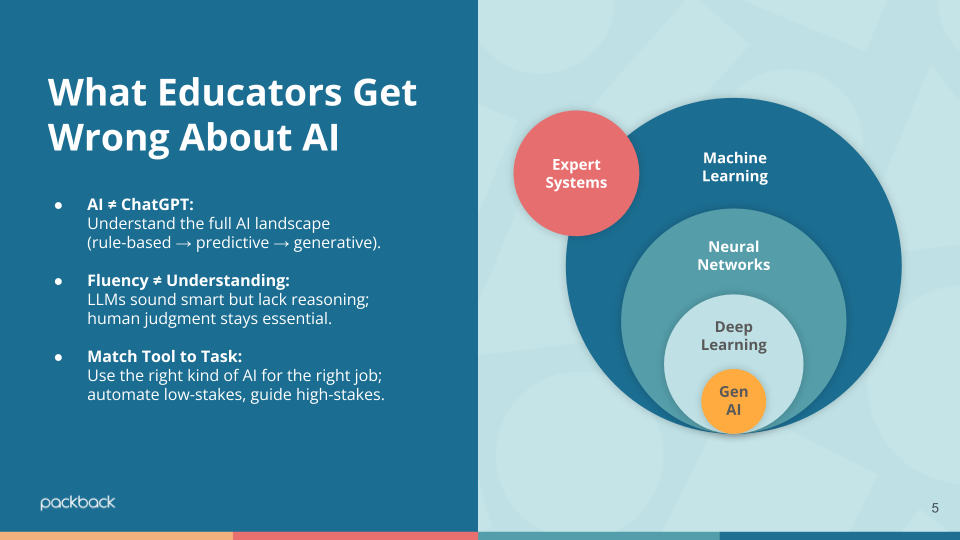
AI is a massive field, and you’ve been interacting with it for decades.
- Expert Systems (1960s): These are simple, rule-based “if-then” systems that came about in the 1960s. Think of the ‘60s chatbot ELISA, which was designed to act like a therapist by following grammatical rules to turn your statements into questions.
- Machine Learning (1980s-90s): This is AI that learns from patterns in data. You use it every day. It’s the spam filter in your inbox, the fraud detection on your credit card, and the recommendation engine on Netflix.
- Deep Learning (2010s): A more advanced form of machine learning that uses “neural networks” inspired by the human brain. This is the technology that allowed a Google AI to “teach itself” to identify cats in YouTube videos just by analyzing millions of unlabeled images.
- Large Language Models / Generative AI (2020s): This is the new kid on the block. It’s a subset of deep learning. GenAI models (or LLMs) are extremely turbocharged autocompletes.
So, what is a Large Language Model (LLM) really doing?
It is not “thinking.” It is not “knowing.” It is not “understanding.” It is a deep learning model trained on vast volumes of text to do one thing: predict what word comes next.
Knowing this, we have to look objectively at the pros and cons of AI in education if we want to solve the integrity crisis. We cannot define academic integrity simply as “the absence of AI.” It must be redefined as the presence of cognitive vigilance and authentic effort. The reality is that offloading work isn’t always a bad thing; students have always offloaded parts of learning through calculators, spellcheck, outlines, and peer review.
A human-centered Al strategy begins with a simple premise: Al should support the learning process, not replace it. Instead of blanket bans, we must look at how AI is being utilized on a spectrum:
- Shortcut: AI produces the answer, and the student bypasses thinking.
- Support: AI gives feedback or clarification, and the student continues thinking.
- Scaffold: AI prompts reflection, revision, and judgment, and the student deepens thinking.
We shouldn’t worry about students offloading tasks. They’ve always done that. What we need to concern ourselves with in this moment is what they offload. When students outsource their reasoning, judgment, and perspective, they bypass the learning entirely.
What Are the Best Alternatives to AI Detection?
The most effective alternative to ai detection is shifting your grading focus from the final polished output to the actual learning process.
Before generative Al, a polished final product was often a reasonable signal that intellectual effort had happened. Now, that signal is less reliable. If a polished final product is no longer a reliable signal of learning, how do we assess students? We take a cue from math class: we grade the steps.
In education, we often reward the view: the polished essay, the correct answer, the clean solution. But the value was always in the messy middle.
The work of learning happens in the moments before the final submission: when students ask questions, test ideas, receive feedback, make revisions, and decide what they actually think. We have to make that process visible.
This transforms the invisible climb into tangible evidence, giving you the exact context you need to evaluate authentic effort instead of guessing at Al involvement.
How to Implement Human-Centered AI in Higher Education? Shift the Focus from Output to Process
A human-centered Al strategy begins with a simple premise: Al should support the learning process, not replace it.
Higher education does not need to choose between banning Al outright and adopting it without structure. The goal is to make the learning process harder to bypass and easier to see.
Recent Articles
-
Webinar Recap: How to Design College Assignments to Promote Critical Thinking & AI Literacy
-
Meet the AI Panic With Pedagogy, Not Policing and Why AI Detection Won’t Fix Academic Integrity
-
A Student Told Me They Were Ethically Opposed to AI. Here’s What I Wrote Back.
-
Make Student Thinking Visible in an AI World (Webinar Recap)