Webinar Recap – After Detection: A Better Way to Know if Learning Happened
Share this Article


Stop policing the final artifact. Discover how shifting from AI detection to process visibility restores trust and proves genuine student learning.
We assume students are cheating with AI at unprecedented rates, but the data tells a completely different story. We need to stop treating classrooms like courtrooms and figure out how to prove that authentic learning actually happened.
Right now, a massive disconnect is driving campus anxiety. Recent surveys reveal a staggering 30-point trust gap between what students are actually doing and what they believe their peers are doing. While 82% of students report they have never used AI to write a full assignment, they are convinced everyone else is using it to cheat.
The result? An environment of mutual suspicion where honest, high-achieving students are terrified of false accusations, and faculty are exhausted by playing detective.
Why Do AI Detectors Fail?
We are not in the midst of a cheating crisis; we are facing a validity crisis.
For decades, higher education has relied on the final artifact (the essay, the report, the exam, etc.) as the sole proxy for student learning. GenAI didn’t break that model, but it has become a catalyst forcing us to recognize that final artifact has always been a weak proxy to determine if true learning occurred. When an algorithm can produce a polished essay in three seconds, grading the final artifact is no longer a valid measure of human cognition.
Institutions have reflexively turned to AI detection in higher ed to restore order, but this approach introduces significant governance risks and triggers faculty-resisted mandates. Detection tools trap us in an adversarial arms race of false positives. They don’t prove learning; they only attempt to prove the absence of a machine.
It’s easy to view the AI transition as an adversarial battle between instructors and students. But when you map out what both groups actually want from the higher education experience, the alignment is striking:

Both faculty and students are craving authentic learning, clear expectations, and mutual trust. By actively teaching students the difference between strategic cognitive offloading and complete cognitive surrender, we validate their desire to build real-world AI skills without sacrificing academic integrity.
If we want to know if learning happened, we must stop leading with detection and start leading with the authorship process. During our recent webinar, we outlined a three-part “Starter Kit” to help faculty transition from policing the artifact to making student thinking visible.
Solution 1: Motivate First
The first step away from cognitive surrender is establishing the “why.” If an assignment feels like busywork, the incentive to offload it completely to an AI is incredibly high.
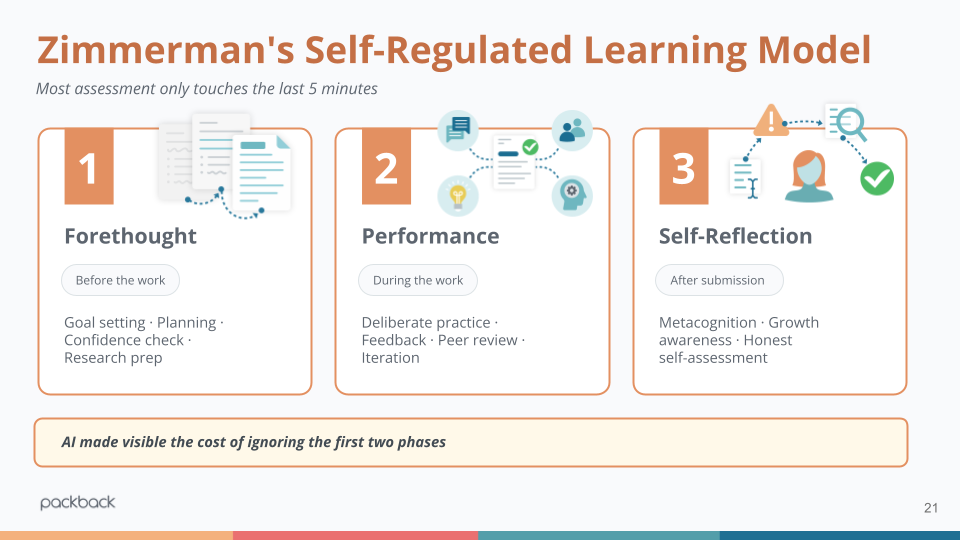
Instead of waiting until week four to discuss AI policies, run a Day 1 goal-setting activity. Be explicit about why the skills they are practicing matter for their survival and success in their future careers. We recommend grounding your approach in Zimmerman’s Self-Regulated Learning Model, which emphasizes Forethought, Performance, and Self-Reflection. When students understand the intrinsic value of the struggle, they are far less likely to bypass it.
Solution 2: Redesign the Process
Faculty are overworked, and grading empty participation or AI-generated filler only compounds the burnout. The solution isn’t to assign more work; it’s to grade different work.
Instead of asking for four major final papers over a semester, consolidate to two submissions, but add visible checkpoints.
- Add a Planning & Purpose Memo.
- Implement a mandatory first draft and peer review step.
- Shift the grade weight heavily toward the reflection, not just the polished paper.
By instrumenting the writing process (outlines, drafts, and revision timelines). you give instructors a simple, intuitive “show your work” view. You assess the authentic effort, saving time while improving student outcomes.
Solution 3: Make AI the Assignment
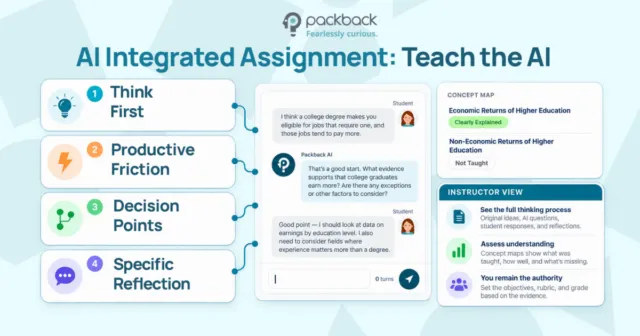
The ultimate way to build cognitive vigilance in an AI-saturated world is to invite the AI into the assignment, but require the student to be the critic.
If you design one professional simulation where students are required to use AI, you can shift the evaluation from the final output to a prompt log and metacognitive synthesis. Have the students critique the AI’s hallucinations, correct its biases, and iterate on its logic.
When you evaluate the process, AI cannot do the heavy lifting of reflection. The learning becomes visible, auditable, and entirely human.
Transitioning away from a detection-first mindset can feel overwhelming, but you don’t have to rewrite your entire syllabus overnight. We’ve developed a three-part Starter Kit to help you incrementally shift toward process visibility:

These steps are not all-or-nothing. You can start small by simply “Motivating First” and adding a ‘why this skill matters’ statement to your prompts tomorrow, or you can go all-in and “Make AI the Assignment” through a professional simulation. Pick one strategy, implement it, and watch student engagement shift from compliance to curiosity.
Recent Articles
-
What Good AI Assignment Design Looks Like, and Why We Built Teach the AI First
-
Webinar Recap: How to Design College Assignments to Promote Critical Thinking & AI Literacy
-
Meet the AI Panic With Pedagogy, Not Policing and Why AI Detection Won’t Fix Academic Integrity
-
A Student Told Me They Were Ethically Opposed to AI. Here’s What I Wrote Back.