How to Design Assignments Where Students Use AI and Still Do the Thinking
Share this Article


The Practitioner’s Guide to AI Integrated Assignments makes student judgment visible while students work with AI. See the 3 categories, 5 design principles, and how to actually grade process.
Students now have access to tools that can produce a competent draft in seconds. For instructors, that makes a familiar question much harder to answer: Did this student build the skill the assignment was designed to teach, and can I see evidence of it?
Bans and detection may have a role in an institution’s AI policy, but neither solves that instructional problem. AI integrated assignments take a different approach by changing what the assignment asks students to do.
What is an AI integrated assignment?
An AI integrated assignment is a structured task where students evaluate, verify, revise, and challenge AI output rather than accepting it, and where every decision they make along the way remains visible to them and to their instructor.
The student stays the senior editor. AI supplies material for the student to judge, and the instructors can see the decisions students make along the way.
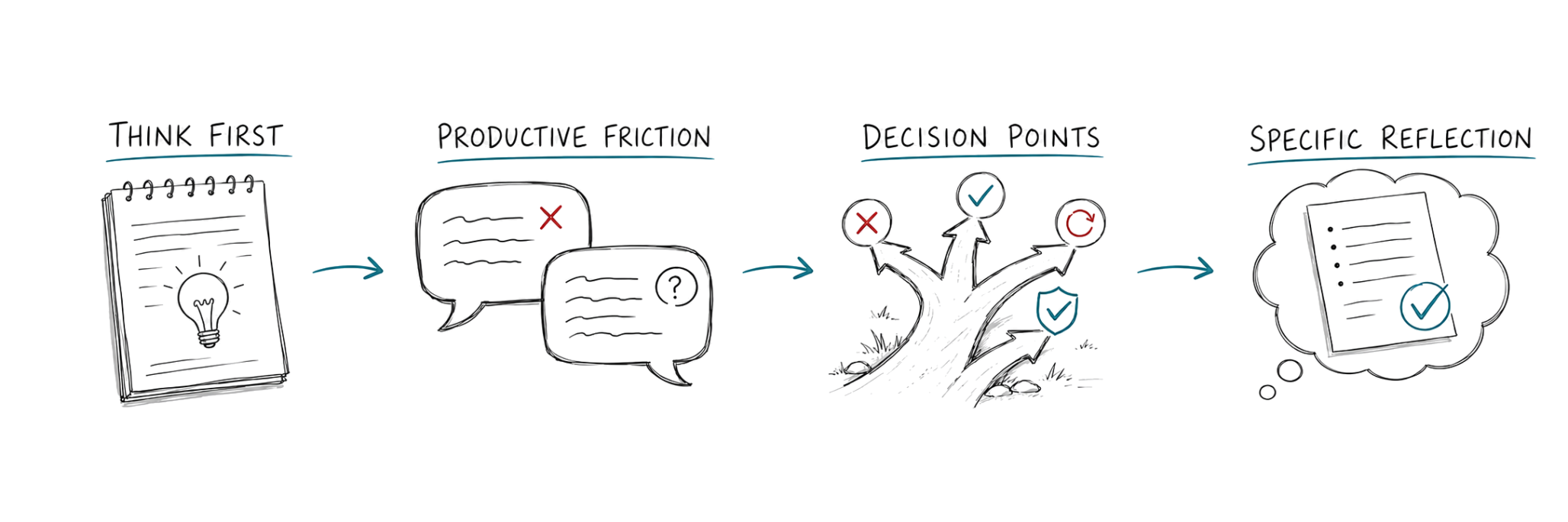
We apply five design principles to keep the students doing the thinking:
- Think first. Students commit a position or a plan before AI enters, which protects original thinking and gives the instructor a baseline.
- Productive friction. The task creates deliberate moments where students have to pause, evaluate, and make a choice rather than simply accepting AI output.
- Decision points. Students repeatedly choose to accept, reject, verify, or transform what AI produces.
- Specific reflection. Students account for concrete moments, a claim they changed or a suggestion they rejected, so reflection is genuine instead of performative.
- Process visibility. The decisions and revisions become a record the instructor can act on and the student can learn from.
The three categories of AI integrated assignments
Packback organizes AI integrated assignments into three categories, each based on the skills students practice.

Close Reading and Analysis builds the skill of evaluating AI output against a trusted source. Students work with a source text and with AI output, treating what AI produces as a claim to verify. Claim-Source Verification asks students to judge AI-generated claims against a trusted source and attach the evidence behind their call.

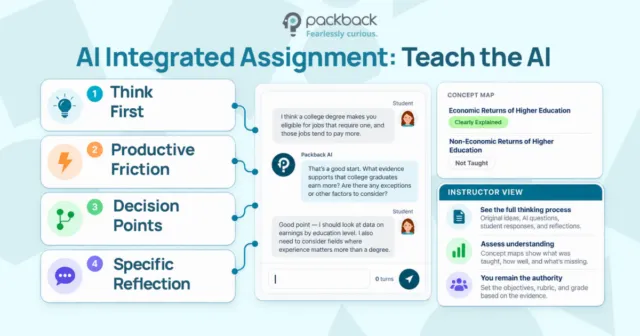
Conversational Reasoning builds the skill of using AI as a thinking partner. AI pushes back, and the student defends, adapts, or corrects. Argument Lab has students develop a position and respond to AI counterarguments. Teach the AI has students explain a concept to an AI playing a novice, then diagnose and correct its misunderstanding.

Co-Writing with AI builds the skill of directing AI and owning the result. Students do the supported research, synthesis, and drafting that most professional writing now involves, while framing the input, refining prompts, and revising. The AI Co-Authored Essay has students plan first, then co-write paragraph by paragraph with a visible log of what they accepted, revised, and rejected.
Additional assignment types are planned throughout the year and into 2027.
Why Conversational Reasoning Came First
One theme we’ve heard from faculty testing these assignments is a gap between critical thinking and critical reading. Students may be capable of questioning an idea while still taking a source (or AI output) too readily at face value.
“We’re finding that they are capable of critical thinking, but not so much critical reading, so this is key.”
Close reading is foundational. A student cannot co-write well or evaluate anything an AI hands them without it, which is why it anchors the first category rather than sitting somewhere in the middle of the sequence.
What changes about grading
Instructors read a decision trail alongside the draft. A decision log from a co-authored essay shows what the student kept and what they threw out. A concept map from Teach the AI shows what the student understood well enough to explain to someone else. A counterargument assessment from Argument Lab shows how the student handled pressure on a position.
Grading moves toward the reasoning. The final prose still matters, and it stops carrying the entire evidentiary load by itself.
Integrating AI Integrated Assignments into Your Course
AI integrated assignments are designed to fit seamlessly alongside your existing Packback assignments. Rather than completely restructuring your syllabus, you can introduce these assignments into your current course workflows to complement ongoing student discussions and writing activities. They drop into existing LMS workflows and existing syllabi.
By pairing AI integrated tasks with core Packback features, instructors can expand skill-building opportunities by giving students practical experience in evaluating AI outputs and documenting their reasoning without disrupting established instructional goals.
Recent Articles
-
Webinar Recap – How Academic Leaders Can Support Faculty with an AI Maturity Model
-
What Good AI Assignment Design Looks Like, and Why We Built Teach the AI First
-
Webinar Recap: How to Design College Assignments to Promote Critical Thinking & AI Literacy
-
Meet the AI Panic With Pedagogy, Not Policing and Why AI Detection Won’t Fix Academic Integrity