Meet the AI Panic With Pedagogy, Not Policing and Why AI Detection Won’t Fix Academic Integrity
Share this Article


Faculty are being told to fight AI with detection software, and roughly 90% now say AI is weakening student learning anyway. Detection asks whether a machine wrote the essay. The better question is whether a student can show you how they got there. Here’s how to answer it.
Talk to almost any provost, dean, or writing instructor right now, and the same worry comes up. Students are using AI to do the thinking they used to do themselves, and in the worst cases, to do the coursework itself. The fear isn’t hypothetical anymore. It has a headline behind it: the New York Times recently reported on students logging AI agents directly into their course management systems so the agent could watch lectures, take quizzes, and write the papers, all while the instructor had no real way to prove any of it happened.
That story landed hard because it confirmed something faculty already suspected. A recent Forbes analysis put a number on it: roughly 90% of faculty now say AI is weakening student learning. That’s not a fringe opinion on one campus. That’s close to consensus across higher ed.
So what do you do with a fear that widespread? The instinct for a lot of institutions has been to fight back with more surveillance: paste tracking, keystroke logging, AI detection software. It’s an understandable response.
It is also, we’d argue, the wrong one.
Why Detection Won’t Win Back Trust and Fails in Higher Education
AI detection software does not reliably identify AI-written student essays and carry a real error rate. That means every flag becomes an accusation a school can’t fully prove and a student can plausibly deny. Faculty are left holding a suspicion instead of an answer, and students are left defending themselves against a machine’s guess. Meanwhile, institutional guidance on what to actually do with a detection flag remains thin. The result is more policing aimed at a problem that policing was never built to solve.
The deeper issue is that detection asks the wrong question. It asks, “did a machine write this?” A better question is, “can this student show me how they got here?” That’s a question no AI tool can answer on a student’s behalf, and it points toward a completely different response to the AI panic: instead of trying to catch what a student did wrong, make it possible to see what they did right.
A Pedagogy First Alternative to AI Detection
Process-based assessment grades how a student planned, drafted, and revised a piece of writing, not only the final draft they turn in. Pedagogy-first is where the field is already headed. Inside Higher Ed has pushed institutions toward a comprehensive view of AI’s role in the university rather than an outright ban. Faculty Focus has published evidence based guidelines for when AI belongs in a course, and a separate piece in the same publication frames AI as a legitimate “cognitive partner” for reflection and formative assessment, grounded in real research and without naming a single commercial tool. A recent scoping review on generative AI and cognitive offloading reaches a similar conclusion: protect learner agency by making student thinking visible, not by trying to make the AI invisible.
Even voices from inside the LMS world are converging here. Matthew Pittinsky, Blackboard’s co-founder and incoming CEO, recently drew a line that closely tracks our own thinking: AI that does the work for a student is a very different thing from AI that helps a student stay in the work. He specifically called for capturing formative signals of learning, not just clicks and submissions, a case for exactly the kind of visibility we believe classrooms need right now.
The common thread across all of this research is simple. Skilled learners aren’t just finishing assignments. They’re planning, monitoring their own progress, and reflecting on what they’ve done, a cycle learning scientist Barry Zimmerman named self regulated learning decades ago. AI makes it easy for a student to skip past all three of those steps. Which means those are exactly the steps worth making visible again.
Making Thinking Visible: Engagement Insights
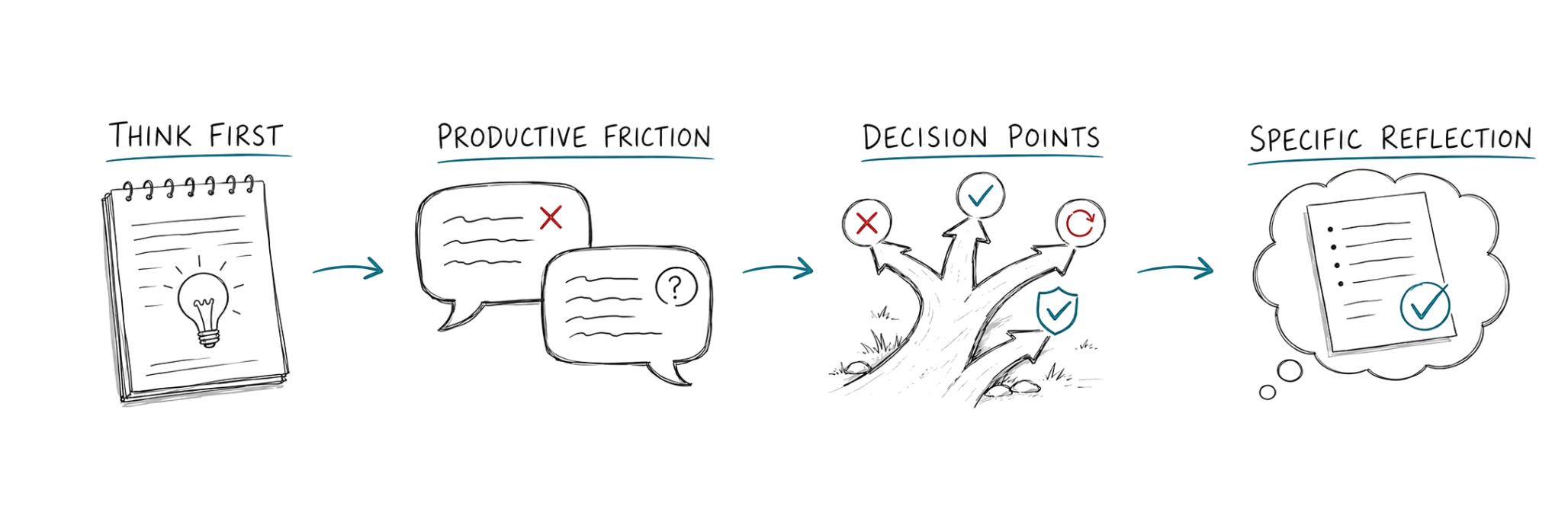
Revealing the thinking process is the idea behind Engagement Insights, a feature set built into Packback Writing. Instead of asserting a policy about academic integrity, it captures actual behavior: how a student planned an assignment, how they drafted and revised it, and how they reflected on what they learned.
Grading the writing process instead of the final draft takes three kinds of visibility:
- Planning. Students now land on a Planning tab by default, so instructors can see whether real prewriting happened, not just whether a draft eventually got turned in.
- Revision. A Writing Process Report shows how long a student spent in each phase of the writing process and flags “one and done” drafting versus genuine iteration.
- Reflection. When a student writes a reflection on their own process, it shows up right next to their grade, not buried in an email an instructor has to go dig up later.
Students now land on a Planning tab by default, so instructors can see whether real prewriting happened, not just whether a draft eventually got turned in. A Writing Process Report shows how long a student spent in each phase of the writing process and flags “one and done” drafting versus genuine iteration, essentially a fingerprint of cognitive engagement. And when a student writes a reflection on their own process, it shows up right next to their grade, not buried in an email an instructor has to go dig up later.
Engagement Insights does not claim to catch AI misuse. It does something more useful: it makes authentic effort visible, which builds a fundamentally different relationship between faculty and students than an accusation waiting to happen.
We also want to be upfront that this is a starting point, not a finished picture. Skills tagging and more direct evidence of student learning are next on our roadmap, and we expect this part of the story to keep growing.
Building AI Literacy Into the Work Itself
Making today’s writing process visible is one half of the answer. The other half is rethinking what AI integrated coursework can look like when it’s designed deliberately, instead of happening to students by accident.
That’s the thinking behind our new AI Integrated Assignments, a set of assignment types built so every one of them makes three things visible: what the student was actually thinking, what role the AI played, and what the student did with that: what they accepted, revised, verified, or pushed back against.
Two of these are live today. In Teach the AI, a student explains a concept to a deliberately novice AI and has to correct its errors, with the AI checking the student’s explanation against a concept map. If the AI’s understanding breaks down somewhere, there’s a good chance the student’s does too, which turns the exercise into a comprehension check instead of a shortcut. In Argument Lab, a student locks in a position and then has to defend it against AI generated counterarguments aimed at their specific claims, practicing exactly the reasoning and revision that a one shot AI essay skips entirely.
Two more are coming this fall. Claim and Source Verification presents claims about a source chosen by the instructor, and the student has to mark each one accurate, misleading, or false and back it up with proof from the text, turning verification itself into the graded work. And in a Co-Authored Essay, a student plans first, then works through a piece paragraph by paragraph, accepting, rewriting, or rejecting each AI suggestion along the way. That decision record, not just the polished final draft, is what gets turned in. That category has a name now: Learning Intelligence.
The Bottom Line
Students are already using AI. Pretending otherwise, or trying to out-detect them, isn’t a strategy institutions can win. The more durable path is building AI into the work itself in ways that keep students in the thinking, and giving faculty real evidence of that thinking instead of a suspicion score.
That’s what we’re building at Packback: tools that don’t ask “did AI write this,” but instead ask, and answer, “can I see how this student got here.”
About the Author

Recent Articles
-
Webinar Recap: How to Design College Assignments to Promote Critical Thinking & AI Literacy
-
A Student Told Me They Were Ethically Opposed to AI. Here’s What I Wrote Back.
-
Make Student Thinking Visible in an AI World (Webinar Recap)
-
AI Assignment Design That Makes Student Thinking Visible (and Gradeable)