Webinar Recap – How Academic Leaders Can Support Faculty with an AI Maturity Model
Share this Article

Polished final essays no longer prove authentic learning. Discover how academic leaders use a 3-stage AI Maturity Model to shift focus from policing to process.
How Higher Ed Leaders Are Navigating the AI Validity Crisis
If your institution is still relying on post-submission AI detectors, you’re fighting a losing battle while risking student trust and burning out your faculty.
Higher education faces a validity crisis because generative AI can produce final course artifacts in seconds which has effectively decoupled the submitted assignment from student competence. Institutions must move from reactive detection to process-based learning intelligence, using structured frameworks that make cognitive effort visible and measurable.
The Chaos Outside and Inside Our Classrooms
From the take-home exam to the study group, generative AI has upended foundational elements of the educational experience. We are seeing a massive disconnect on campuses: leadership sees AI’s potential, yet 78% of institutions offer no practical classroom guidance for their faculty’s own AI use. This lack of direction leaves educators frustrated, overwhelmed, and completely exhausted. As one attendee noted, an “authenticity gap” has emerged where neither teachers nor students fully trust that the artifacts of learning were created by a human.
Without clear guidance, the natural instinct is to clamp down and campuses start to fall into the “Nanny State” trap with an over-reliance on surveillance, keystroke tracking, and AI detection tools to police student work. But this approach is fundamentally flawed. Detectors consistently miss careful users, severely erode trust when authentic student writing gets flagged, and lead to massive faculty burnout. A 99% accuracy rate sounds impressive until you realize it means a 1% false-positive rate, effectively flagging 1 out of 100 innocent submissions as cheating. This adversarial policing mindset directly contradicts authentic retention goals and fails to teach students the critical skills they need to survive in the modern workforce.
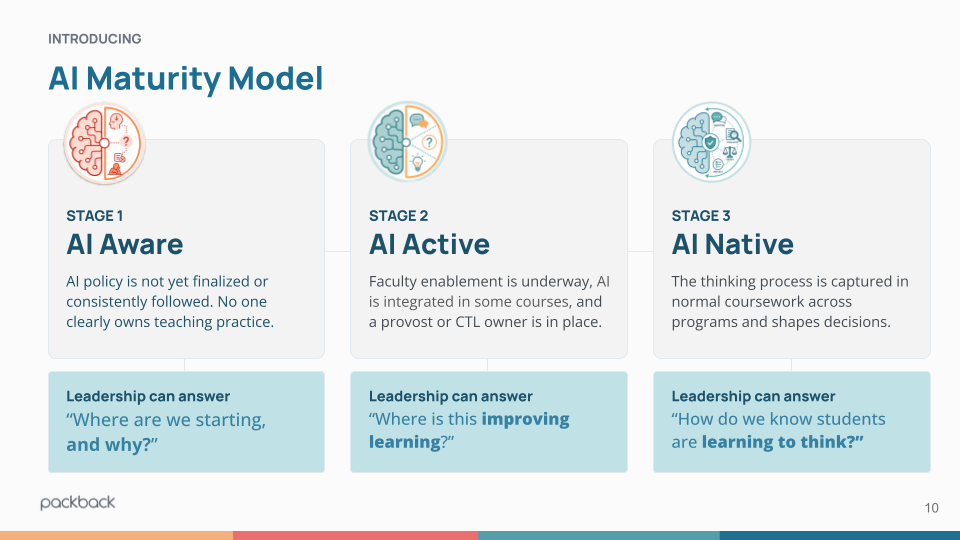
To move from chaos to calm, leadership needs a shared map. The AI Maturity Model provides a pathway for institutions to advance their teaching, learning, and academic integrity policies in the AI era.
Stage 1: AI Aware.
Characterized by ad-hoc classroom experiments, policy menus, and isolated departmental champions. AI policy is often not yet finalized or consistently followed. During our live webinar poll, 31% of attendees admitted their institution has no faculty AI guidance at all, while the majority are stuck in a gray area where guidance exists but only some faculty use it. The primary question leadership can answer here is: Where are we starting and why?
Question answered: Where are we starting and why?
Stage 2: AI Active.
Characterized by hands-on faculty development, syllabus disclosure norms, and robust process evaluation. Faculty champions are actively working in communities of practice to preserve student thinking.
Question answered: Where is AI improving learning?
Stage 3: AI Native.
Characterized by longitudinal process data rolled into accreditation cycles and program reviews. AI is seamlessly used to coach student thinking, and detection is rarely needed because process evidence is the default.
Question answered: How do we know students are learning to think?
Taking Action Before Next Term
You don’t need to reach “AI Native” overnight. Progress starts with small, intentional steps to make thinking visible and support your faculty on the frontlines.
- Establish departmental points of contact: Ensure every academic department has a dedicated point of contact to aggregate pedagogical needs and provide a direct line to leadership.
- Shift evaluation criteria: Stop assessing the final static text and start evaluating scaffolded drafting phases. Ask students to submit their work history with their work, shifting the focus from the product to the learning process.
Recent Articles
-
What Good AI Assignment Design Looks Like, and Why We Built Teach the AI First
-
Webinar Recap: How to Design College Assignments to Promote Critical Thinking & AI Literacy
-
Meet the AI Panic With Pedagogy, Not Policing and Why AI Detection Won’t Fix Academic Integrity
-
A Student Told Me They Were Ethically Opposed to AI. Here’s What I Wrote Back.