From Detection to Prevention: Building Infrastructure for Cognitive Vigilance
Share this Article


Generative AI broke the traditional grading model by proving that a polished final essay no longer guarantees actual learning occurred. Enter Learning Intelligence: the new category of educational technology that stops trying to catch AI, and instead instruments the writing process to make authentic student effort visible, auditable, and grading-friendly.
Let’s be honest: generative AI quietly broke the basic contract of formal education. Back in the fall of 2022, a freshman writing instructor could still reasonably believe that the essay sitting in her grading queue was an accurate record of her student’s thinking.
By 2026, that assumption is gone. The HEPI Student Survey revealed that 88% of undergraduates use generative AI specifically on assessed work, and 95% of faculty expect AI to increase student overreliance while diminishing critical thinking.
The immediate reaction across most campuses? A heavy reliance on syllabus-level bans and post-submission “AI detectors.” But academic leaders are quickly realizing that punitive surveillance is an unsustainable (and losing) cat-and-mouse game. It erodes classroom trust, creates a nightmare of false accusations, and does absolutely nothing to certify that learning actually happened. We do not have a cheating crisis; we have a validity crisis.
Higher education must transition away from reactive policing and build actual instructional infrastructure designed for cognitive vigilance.
What is Learning Intelligence in Education?
Learning Intelligence is a pedagogical framework and software category that instruments the student writing process to make critical thinking visible. Unlike traditional learning analytics that simply monitor course engagement or click counts, Learning Intelligence maps active student authorship to specific pedagogical constructs to improve teaching, learning, and assessment.
When written outputs can be generated in seconds for free, we can no longer evaluate learning by the final artifact alone. By integrating instructional AI directly into course assignments, we can evaluate how students arrived at their conclusions. We are not here to catch students; we are here to make thinking visible.
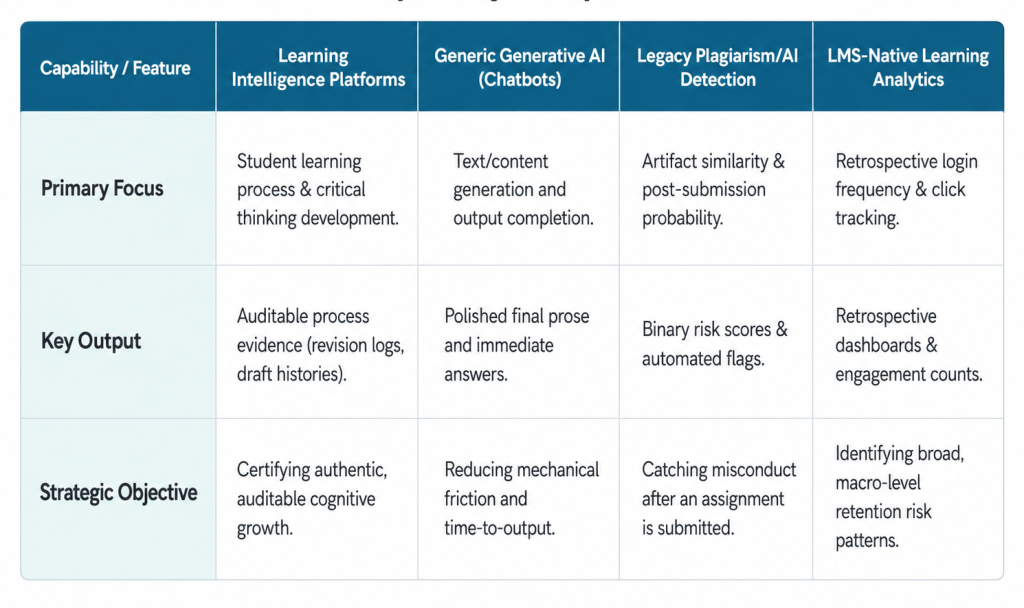
To guide their institutions forward, administrators must understand how this new category differs from generic generative AI, legacy plagiarism checkers, and classical analytics:
Escaping “Dead Education Theory”
Cognitive vigilance is an active, critical stance where students query, verify, and revise AI outputs rather than accepting them blindly. By embedding structural friction and metacognitive prompts into assignments, instructors ensure students remain active agents in the construction of meaning.
If we don’t build assignments that demand this kind of critical evaluation, we risk falling into dead education theory: a dangerous loop where an instructor generates a prompt for the student, the student inputs a prompt, copies the AI output which is then graded by an AI, and receives a grade with near-zero learning actually occurring.
To combat this, institutions must map student behavior across a clear cognitive spectrum:
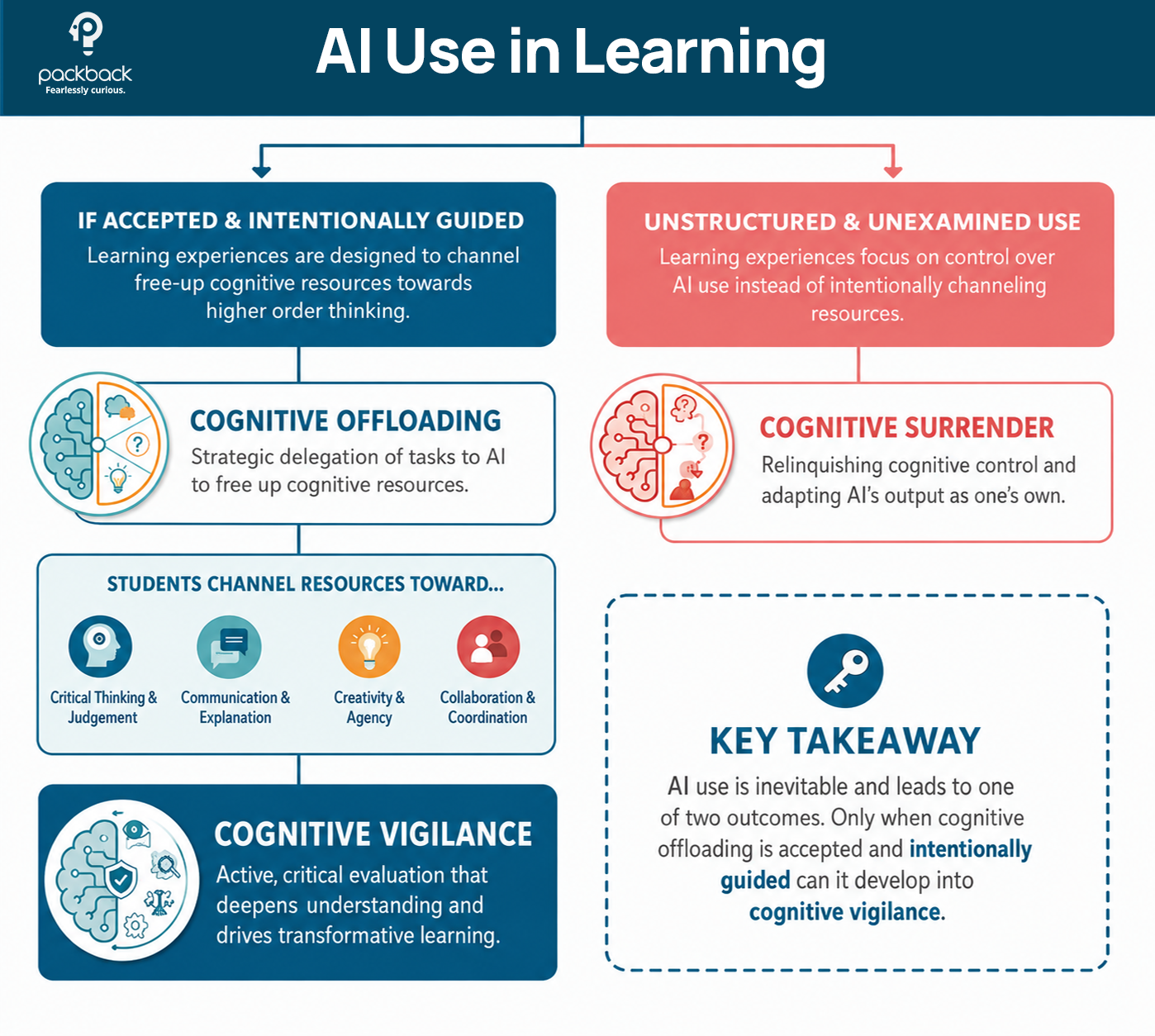
- Cognitive Offloading (Strategic Delegation): Delegating discrete, lower-level tasks (like spelling or structural formatting) to AI to free up mental energy for more complex, higher-order reasoning. This is a normal and useful starting point in modern knowledge workflows.
- Cognitive Surrender (Core Skills Erosion): A serious abdication of critical evaluation where the student relinquishes cognitive control and adopts the AI’s reasoning as their own. This bypasses the “desirable difficulties” that encode long-term learning.
- Cognitive Vigilance (The Design Goal): An active, reflective posture where students critically evaluate AI outputs—checking claims against evidence, identifying bias, and revising for authentic voice.
Generic “AI literacy” standalone modules fail because they are separated from authentic coursework. True cognitive vigilance can only be cultivated when students practice these habits inside real disciplinary tasks.
The Strategic and Financial ROI of Process-Based Infrastructure
Implementing process-based grading infrastructure drives institutional success by directly improving student retention and reclaiming significant faculty grading time. By shifting rubrics away from final drafts and toward visible authorship timelines, universities protect their degree value and eliminate the reputational risks associated with false plagiarism accusations.
For Provosts, Deans, and Chief Academic Officers, the business case for transitioning is grounded in three measurable areas:
- Retention and Tuition Preservation: Student engagement is the single strongest signal of learning, and it is directly tied to persistence. Foundational Nessie studies show that a single standard-deviation increase in student engagement raises the odds of second-year student retention by 17%.
- Faculty Workload and Burnout: Teaching in an AI-saturated environment has dramatically increased faculty workloads. By utilizing a digital tutor for the routine mechanics of grammar, structure, and citation feedback, instructors save an average of 30% of their grading time per essay, freeing up valuable energy for high-impact human mentorship.
- Eliminating Plagiarism Detection Liabilities: Post-submission AI detectors operate as a “black box” and often incorrectly identify students’ use of AI. Some providers boast a 99% accuracy rate, which functionally accepts a 1% false positive rate. Which, of course, means hundreds of innocent students are routinely and incorrectly accused. Shifting to a standard of process evidence (like draft histories) provides a highly defensible policy shield that drastically reduces academic integrity appeals.
The Three-Layer Learning Infrastructure
A comprehensive learning intelligence strategy requires a unified three-layer software architecture, rather than a disjointed set of point solutions. This structural approach guarantees that all learning insights remain explainable, pedagogically grounded, and compliant with enterprise security standards.
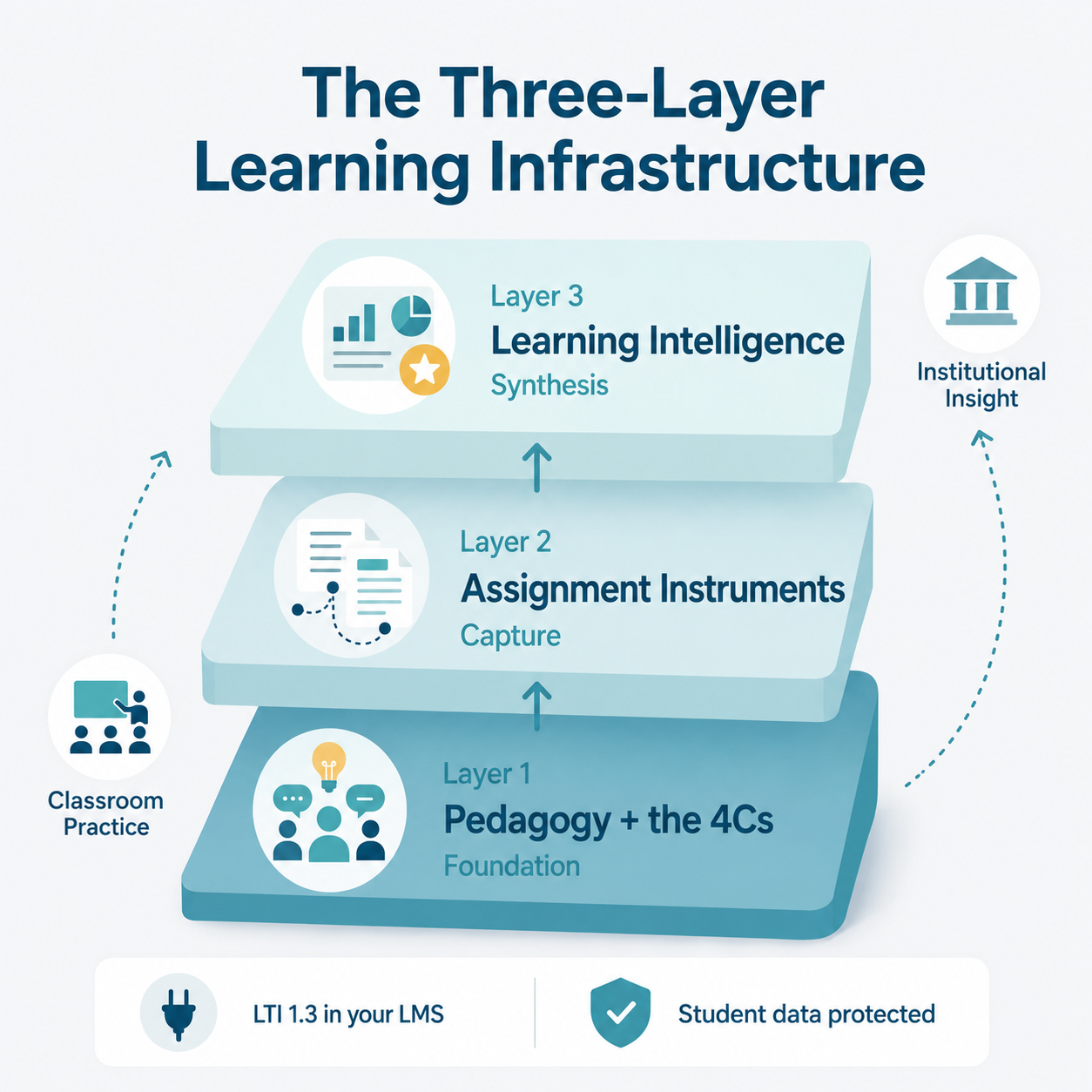
- Layer 1: Pedagogy and the 4Cs (The Foundation): Grounding assessments in observable behaviors mapped directly to Critical Thinking, Communication, Collaboration, and Creativity, paired with their AI-literacy partners (Judgment, Explanation, Coordination, and Agency).
- Layer 2: Assignment Instruments (The Capture Layer): Deploying ready-to-use, discipline-flexible assignment designs (such as Claim–Source Verification and AI-First Drafts) that automatically capture student decision histories and draft evolutions.
- Layer 3: Learning Intelligence (The Synthesis Layer): Aggregating daily classroom-level efforts into programmatic outcome dashboards. This provides academic leadership with immediate, audit-ready evidence portfolios for accreditors.
For the CIO and technical buyer, this transition is entirely low-friction. This infrastructure operates natively on LTI 1.3 Advantage rails within existing Learning Management Systems (Canvas, Blackboard, Brightspace), adhering to the golden rule of data trust: we do not sell student data, and we do not use student submissions to train foundational AI models.
Certifying Learning in 2030
In an economy where polished written outputs are cheap, evidence of original human thinking is everything. Higher education institutions must decide what business they are in: selling transactional credentials, or certifying real cognitive growth. The campuses that invest in visible process evidence will protect their degree value, support their faculty, and prepare highly employable, cognitively vigilant graduates.
Recent Articles
-
Webinar Recap: How to Design College Assignments to Promote Critical Thinking & AI Literacy
-
Meet the AI Panic With Pedagogy, Not Policing and Why AI Detection Won’t Fix Academic Integrity
-
A Student Told Me They Were Ethically Opposed to AI. Here’s What I Wrote Back.
-
Make Student Thinking Visible in an AI World (Webinar Recap)