How to Operationalize AI Literacy via Process-Oriented Assignment Design
Share this Article


Your students are already using generative AI to draft essays, and faculty are thoroughly exhausted from playing AI cop with unreliable detection tools. The traditional final writing artifact can no longer serve as the sole proof of learning. But that doesn’t mean academic rigor is dead!
How Do Institutions Move Past AI Detection?
Higher education institutions move past AI detection by shifting their focus from the finalized text to the visible writing process. Instead of trying to “catch” students by policing final drafts with unreliable tools that trigger false positives, leading universities are adopting process-oriented assignment design that guides students and focuses how they think, draft, and revise.
Vague institutional policy statements and adversarial detection tools have done little to curb academic anxiety. Instead, they have created a toxic culture of surveillance, heightened campus controversy over false positives, and left faculty stuck under an avalanche of grading and AI verification tasks.
During our recent live webinar, Operationalizing AI Literacy Through Assignment Design, we talked with and polled nearly 200 higher education leaders, instructional designers, and faculty about their current reality. The data paints a clear picture of an institutional breaking point:
- An Assessment Bottleneck: 35% of educators state that assessing authentic understanding is the single hardest area to adapt or improve in the AI era, closely followed by 30% who struggle simply to design assignments that still “work.”
- The Loss of Student Agency: When asked what is hardest to build into current coursework, 38% pointed directly to preserving the “productive struggle” of learning, while 46% admitted they are struggling to capture the process, reflection, and student agency all at once.
- Structural Roadblocks: Why aren’t we fixing this faster? Respondents were evenly split between a lack of faculty time and capacity (22%), acute concern over student misuse (23%), and simply not knowing what a “good” assessment redesign actually looks like (21%).
Evaluating only the final product is no longer sustainable. To achieve true operationalizing AI literacy in higher education, campuses must transition from an adversarial “policing” model to a developmental “coaching” model.
We must stop asking “How do we catch them?” and begin asking “How do we make their thinking visible?”
What Is Process-Based Assessment in Higher Education?
Process-based assessment in higher education is an educational framework that evaluates a student’s active learning journey like brainstorming, outlining, drafting, and revising, rather than only grading the final submission.
It instruments the workflow of learning, turning raw process data into actionable, formative feedback.
Shifting away from punitive detection requires a structural architecture. During our live session, the Packback product and research teams broke down the Learning Intelligence Framework which is a three-tiered approach to modern assignment design that scales authentic assessment without breaking institutional workflows.
1. Pedagogy (Your Foundation)
Assignments must be rooted in Self-Determination Theory, prioritizing intrinsic motivation, curiosity, and critical thinking. When students understand the why behind their work and feel a sense of autonomy, the temptation to blindly offload cognitive tasks to an LLM plummets.
2. Assessment (Active Signals)
Instead of waiting for a final draft to run through a flawed detector, instructors need active visibility into the student workflow. This means gathering formative signals while a student is actively learning: building an outline, tracking line-of-inquiry choices, charting revision timelines, and analyzing how a student acts on feedback.
3. Learning Intelligence (The Workflow Layer)
Raw telemetry data is useless if it creates an administrative headache. Learning Intelligence platforms synthesize process data (tracking where a student paused, altered text, challenged an AI output, etc.) into clear, intuitive dashboards.
This gives faculty an instant, auditable view of a student’s authentic effort without adding hours to their grading workload.
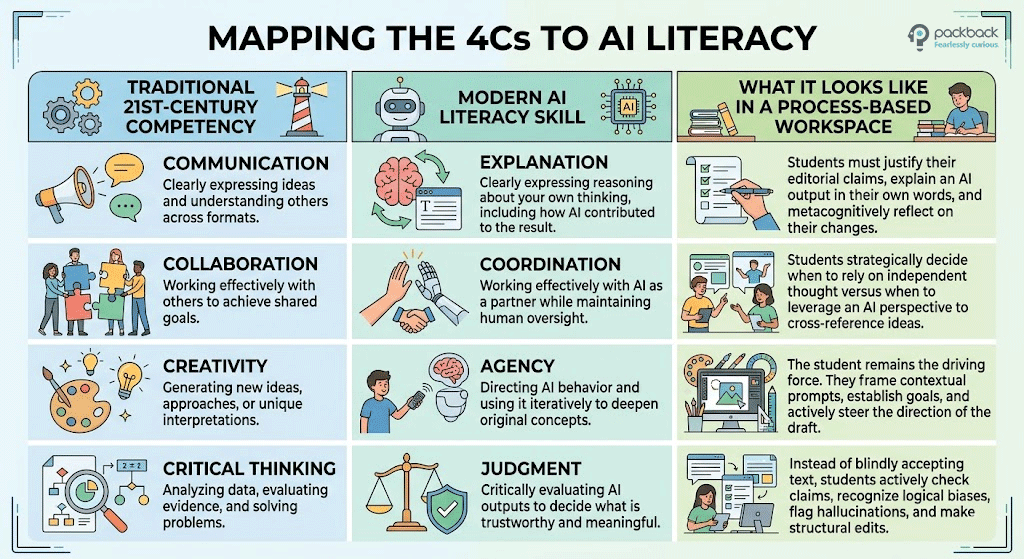
Use the 4Cs of 21st Century Learning As a Framework for Visible Learning
The good news is that we don’t need to reinvent the wheel to build this framework – but we do need to design courses for the traditional “4 Cs” of 21st-century learning (established by the National Education Association to define core modern workplace competencies) that translate directly into real-world AI Literacy Skills:
Mapping the 4Cs to AI Literacy
How to Build AI Literacy Through Assignment Design?
Building AI literacy through assignment design requires restructuring coursework to treat generative AI as a transparent collaborator rather than a shortcut. This means creating scaffolded prompts that require students to critique AI outputs, verify data, and document their intellectual choices.
To understand how this shift changes everything, you have to look at what happens across an institution during a single, routine academic dispute under the old “policing” model.
Why the Whole Campus Inherits the AI Dilemma
To understand why traditional AI detection fails, you have to look at what happens across an institution during a single, routine academic dispute.
Picture a typical Friday afternoon. A professor runs a final essay through a standard AI detector.
It flashes a red “🚩85% Probability of AI Generation.”
The professor, already exhausted by an unsustainable grading load, feels a mix of frustration and dread. They flag the student for academic dishonesty. The student, terrified and defensive, claims they only used an AI tool for basic grammar editing, to better understand the topic, and brainstorming (or not at all).
Suddenly, this single paper triggers a nightmare domino effect across the campus:
- That Faculty Member is now staring down hours of documentation, uncomfortably acting as a prosecutor rather than an educator, wondering if they can even trust their own grading rubrics anymore.
- The Center for Teaching and Learning (CTL) gets a frantic wave of emails. The Director of the CTL realizes their team is caught in a perpetual cycle of firefighting with emergency workshops on AI policies rather than doing what they love: helping faculty design innovative, inspiring, and scalable course structures.
- The Academic Affairs Office braces for a formal grievance. The Provost recognizes that this adversarial friction creates massive governance risks, leaves the institution open to liability regarding unreliable tools, and damages student retention. Every hour spent policing false positives is an hour stolen from measuring and improving real student outcomes.
- The Chief Information Officer (CIO) looks at the IT ticket queue. They see faculty attempting to purchase fragmented, one-off detection plugins on departmental credit cards resulting in messy vendor data silos, massive accessibility vulnerabilities, and nightmare privacy postures that bypass the institution’s existing LMS and SSO rails.
- Students walk away feeling watched rather than coached, concluding that their unique voice doesn’t matter because an algorithm decided their authentic effort looked like “busywork.”
Requiring visible milestones like interactive outlines, documented revision choices, and reflections on how AI text was evaluated builds AI literacy for the student while the professor gets bulletproof proof of human authorship. CTLs gain a clear framework to train faculty at scale. Academic Affairs preserves institutional integrity without governance blowback. IT sleeps easy knowing everything runs safely inside the existing LMS. And students feel valued for how they think, not just what they turn in.
In practice, an assignment designed to build AI literacy might look something like:
Generate an initial outline using an AI assistant on the economic causes of the Fall of Rome.
Write a short reflection identifying two historical biases or errors in that outline.
Document how you adapted your own final thesis to correct them
The result is visible metacognition, verified human learning, and zero paranoia for you.
Moving Toward Visible Learning
Transitioning away from the toxic cat-and-mouse game of AI detection requires elevating our methodology to match the world our students are stepping into. When we give instructors (and students!) the tools to see student writing and thinking progress in real time, we stop being tech police and start being educators again.
Recent Articles
-
Webinar Recap: How to Design College Assignments to Promote Critical Thinking & AI Literacy
-
Meet the AI Panic With Pedagogy, Not Policing and Why AI Detection Won’t Fix Academic Integrity
-
A Student Told Me They Were Ethically Opposed to AI. Here’s What I Wrote Back.
-
Make Student Thinking Visible in an AI World (Webinar Recap)