Cognitive Offloading vs. Cognitive Surrender: Are You Grading the Artifact or the Thinking?
Share this Article


Students don’t want to feel dumb. Learn how to prevent cognitive surrender and design assessments that build cognitive vigilance in an AI-saturated world.
Something is going wrong in higher education. High-achieving students are watching their authentic work get treated with suspicion. At the same time, students who have embraced AI are beginning to say something equally troubling: they feel less intelligent than they did before.
This isn’t just a cheating crisis. It’s a validity crisis. And our obsession with the final artifact may be causing us to lose sight of the student entirely.
Students don’t want to feel dumb. To support them, we need to understand the fundamental difference between cognitive offloading and cognitive surrender, and fundamentally change how we design assessments.
We often hear that generative AI has triggered a massive, unavoidable cheating epidemic. But before we mandate sweeping, adversarial detection policies, we need to look at what students are actually doing. In a January 2026 survey of nearly 700 undergraduates, the data revealed a massive disconnect between perception and reality:
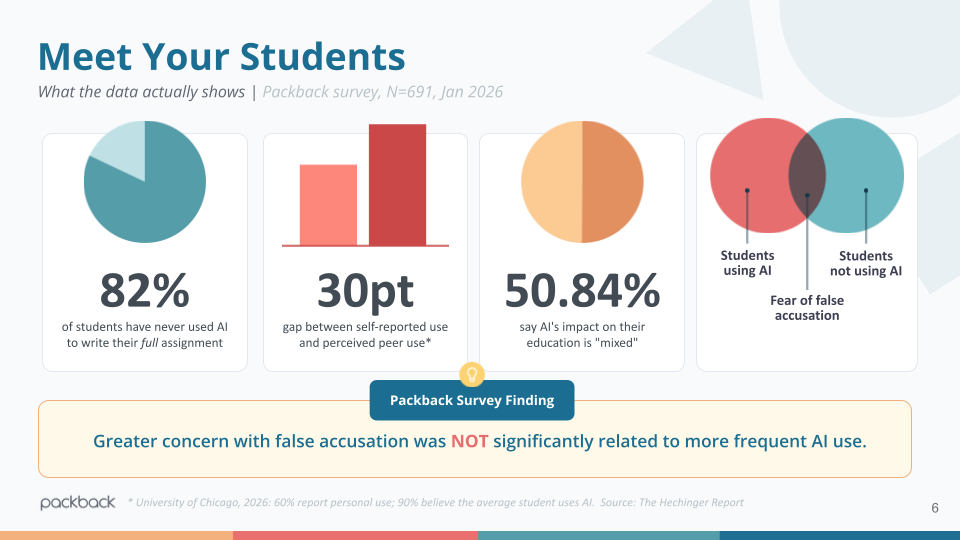
While 82% of students report they have never used AI to write a full assignment , there is a glaring 30-point gap between how they use it and how they assume their peers are using it. Turns out the crisis is widespread anxiety, not widespread cheating. Yikes. Students are terrified of false accusations, and this trust gap is exactly why doubling down on AI detection only breeds a culture of mutual suspicion rather than genuine learning.
To effectively guide students, we must clearly define how they interact with AI tools.
- Cognitive Offloading (Strategic Delegation): This is the act of delegating tasks to AI. When a student offloads a task, they are still retaining their critical thought. They are acting as a manager, using AI to outline, format, or check code, while maintaining total ownership of the ideas.
- Cognitive Surrender (The Failure State): This occurs when a student completely delegates their thinking and critical judgment to an AI tool. Instead of using the tool to aid their workflow, they remove their own judgment from the equation entirely. As one student noted in our recent survey, this phenomenon has “severely diminished the feeling I have of the work being ‘mine.'”
- Cognitive Vigilance (End Goal): The active, systematic scrutiny of AI output. It requires the student to verify reasoning, cross-reference sources, and provide a “misconception audit.”
When we rely solely on AI detectors and grade only the final artifact, we inadvertently punish our best students and push them toward cognitive surrender. Don’t just take our word for it – listen to how students describe the psychological toll of this high-suspicion environment:
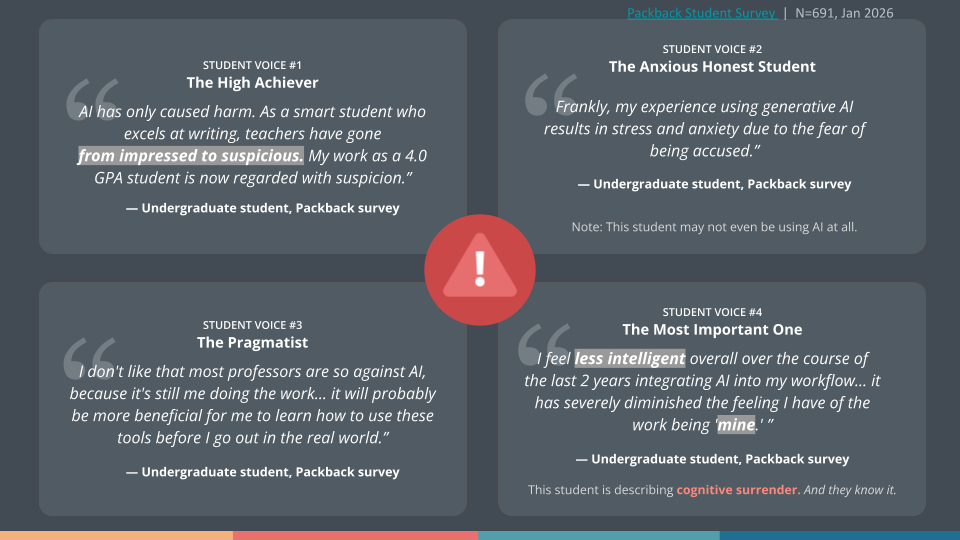
These are all concerning but two really stick out the most for us:
The High Achiever: “AI has only caused harm. As a smart student who excels at writing, teachers have gone from impressed to suspicious. My work as a 4.0 GPA student is now regarded with suspicion.”
The Most Important One: “I feel less intelligent overall over the course of the last 2 years integrating AI into my workflow… it has severely diminished the feeling I have of the work being ‘mine.’”
This is the true danger of cognitive surrender. When students completely delegate their thinking to an algorithm, they lose their sense of ownership and capability. Our job is not to police them, but to design assessments that restore that ownership.
The Goal: Building Cognitive Vigilance
The solution is not to ban AI or rely on detection tools that fail to protect genuine learning. The goal is to implement practical, tactical frameworks for process-based learning that actively prevent cognitive surrender.
Instead of passive acceptance of AI outputs, we need to train students in cognitive vigilance. This means teaching them to systematically scrutinize, evaluate, and iterate upon the information generative AI provides. We must shift our focus from policing the final product to making the thinking visible.
How to Fix It: Shift the Grade Weight with Process-Based Grading
We must stop grading just the output and start grading the process to prevent cognitive surrender. If the final product dictates the entirety of the grade, the incentive to bypass the learning process remains high. By shifting the grade weight to the journey, you make authentic learning more valuable than a polished, AI-generated essay.
If we want to stop grading the final, easily-faked artifact, we need a vetted framework to measure the thinking process. Instead of waiting until the final five minutes of an assignment to evaluate learning, we recommend grounding your course design in Zimmerman’s Self-Regulated Learning Model:
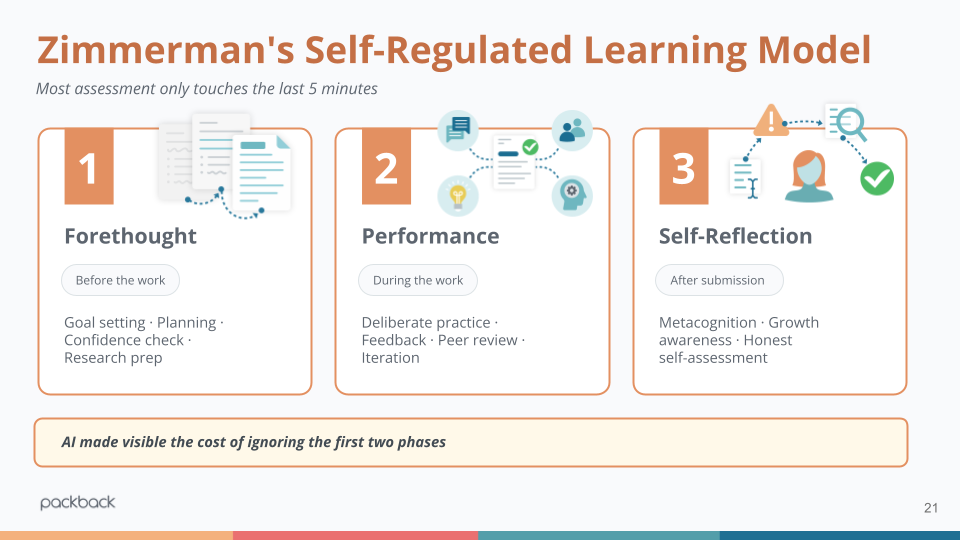
By breaking an assignment down into Forethought (planning), Performance (drafting), and Self-Reflection (metacognition), you make the invisible work of learning visible. This provides you with concrete, gradable checkpoints to assess genuine effort before an AI can simply generate a polished final product.
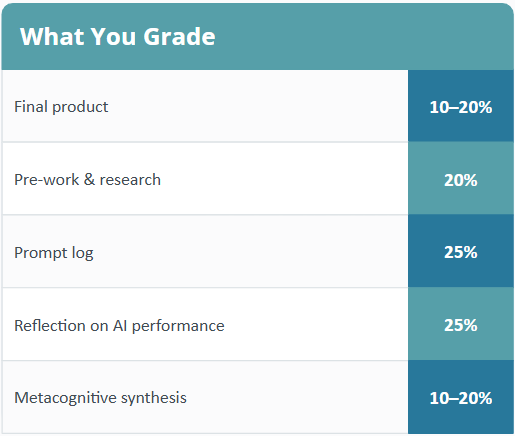
- Pre-work & Research: 20% of the grade.
- Prompt Log: 25% of the grade.
- Reflection on AI Performance: 25% of the grade.
- Metacognitive Synthesis: 10–20% of the grade.
- Final Product: Only 10–20% of the grade.
Cognitive surrender becomes harder to fake than doing the actual work when the majority of the grade evaluates the depth of a student’s metacognition rather than the polish of their final product. A student who can write a detailed reflection about why they revised their thesis demonstrates significantly more learning than a student who submits a perfect paper with no visible process.
Ready to take the next step in course design?
Recent Articles
-
Webinar Recap: How to Design College Assignments to Promote Critical Thinking & AI Literacy
-
Meet the AI Panic With Pedagogy, Not Policing and Why AI Detection Won’t Fix Academic Integrity
-
A Student Told Me They Were Ethically Opposed to AI. Here’s What I Wrote Back.
-
Make Student Thinking Visible in an AI World (Webinar Recap)