Webinar Recap – Designing for Engagement: Using AI to Strengthen Learning, Motivation, and Mastery
Share this Article

AI can either weaken learning or deepen it. This recap breaks down how Instructional AI can increase engagement, strengthen mastery, and support motivation without creating student dependence.
AI is already reshaping the mechanics of the classroom, but for higher education leaders, the real question is one of impact. In an era where every week brings new tools and new promises, instructors are feeling overwhelmed, while administrators face unclear ROI and mounting equity concerns. If we don’t ground technology in solid pedagogy, we risk creating a “dead education loop” where AI does the thinking and students simply offload the thinking required to learn it.
If you’re feeling the pressure to “AI-proof” your syllabus while also being told to innovate, you aren’t alone. We recently sat down with Dr. Craig Booth (CTO at Packback) and Oliver Short (Director of Product & Design at Packback) to discuss how to shift the focus from “policing” AI to proactively designing for mastery.
Watch the On-Demand Recording & Access the Slide Deck: Designing for Engagement
Don’t have an hour? Keep reading for the high-level framework.
Does AI Improve Student Engagement?
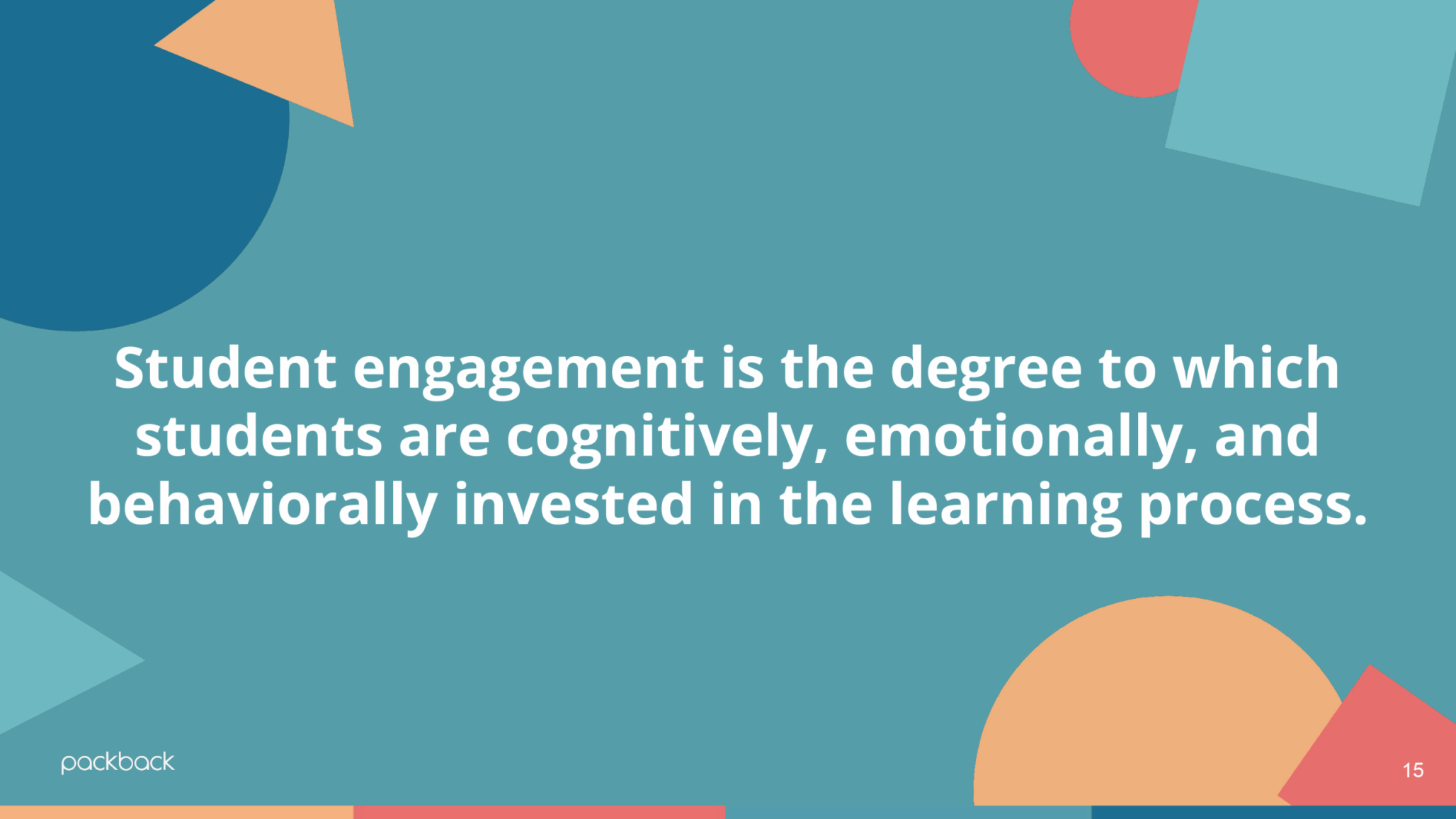
Student engagement is the degree to which learners are cognitively, emotionally, and behaviorally invested in the learning process. The short answer: yes, AI does improve student engagement, but only if it is designed to prioritize process over product.
Student engagement is the causal driver behind every metric that matters to an institution: GPA, completion, and long-term equity.
Research from George Kuh and the National Survey of Student Engagement (NSSE) shows that participation in “educationally purposeful activities” is directly related to persistence between the first and second years of college.
The numbers are striking:
- Retention Spikes: Participation in educationally purposeful activities raises the odds of second-year retention by 17%.
- Equity Gaps Close: When less-engaged students are exposed to interactive peers, they are 6.3 percentage points more likely to enroll next term.
- Reducing Failure: Active learning techniques, a core component of high engagement, have been shown to reduce D/F/W rates by 33-55%.
Engagement is your school’s strongest retention tool because it lifts performance AND prevents attrition.
We polled the 100+ educators and administrators who joined us live on where they currently see the strongest student engagement, and 33% identified applied or real-world tasks, while 30% pointed to discussions or debates. These findings underscore the importance of Social Presence and Cognitive Presence – two pillars of the Community of Inquiry framework that ensure students don’t just “click,” but actually connect.
Choosing Mastery Over Output
As defined by Benjamin Bloom, mastery learning is the educational approach that all students can learn high-level skills provided they receive the necessary time, feedback, and targeted support. Instead of measuring students against fixed time constraints, mastery learning uses explicit, criterion-referenced objectives. AI can serve as that “tutor” by providing frequent, actionable feedback that characterizes astery learning, which focuses on outcomes over outputs. If AI can generate a perfect essay, the “output” is a commodity. We must instead assess the journey: the draft, the revision, and the reflection.
What Are the Benefits of AI in Education?

When implemented ethically, AI allows us to operationalize Bloom’s “2 Sigma Problem,”which is the finding that students receiving one-on-one tutoring perform two standard deviations better than those in group settings.
That’s where pedagogically-grounded Instructional AI comes in with:
- Personalized Feedback at Scale:
AI can provide the frequent, actionable feedback that characterizes high-impact tutoring. - Instructional Visibility:
It makes student thinking visible to instructors, allowing for earlier identification of at-risk learners. - Learning Gains:
Research shows that AI-supported tutoring can actually outperform traditional active learning by providing immediate formative checkpoints.
Not All AI Use is Beneficial
We must establish a clear boundary:
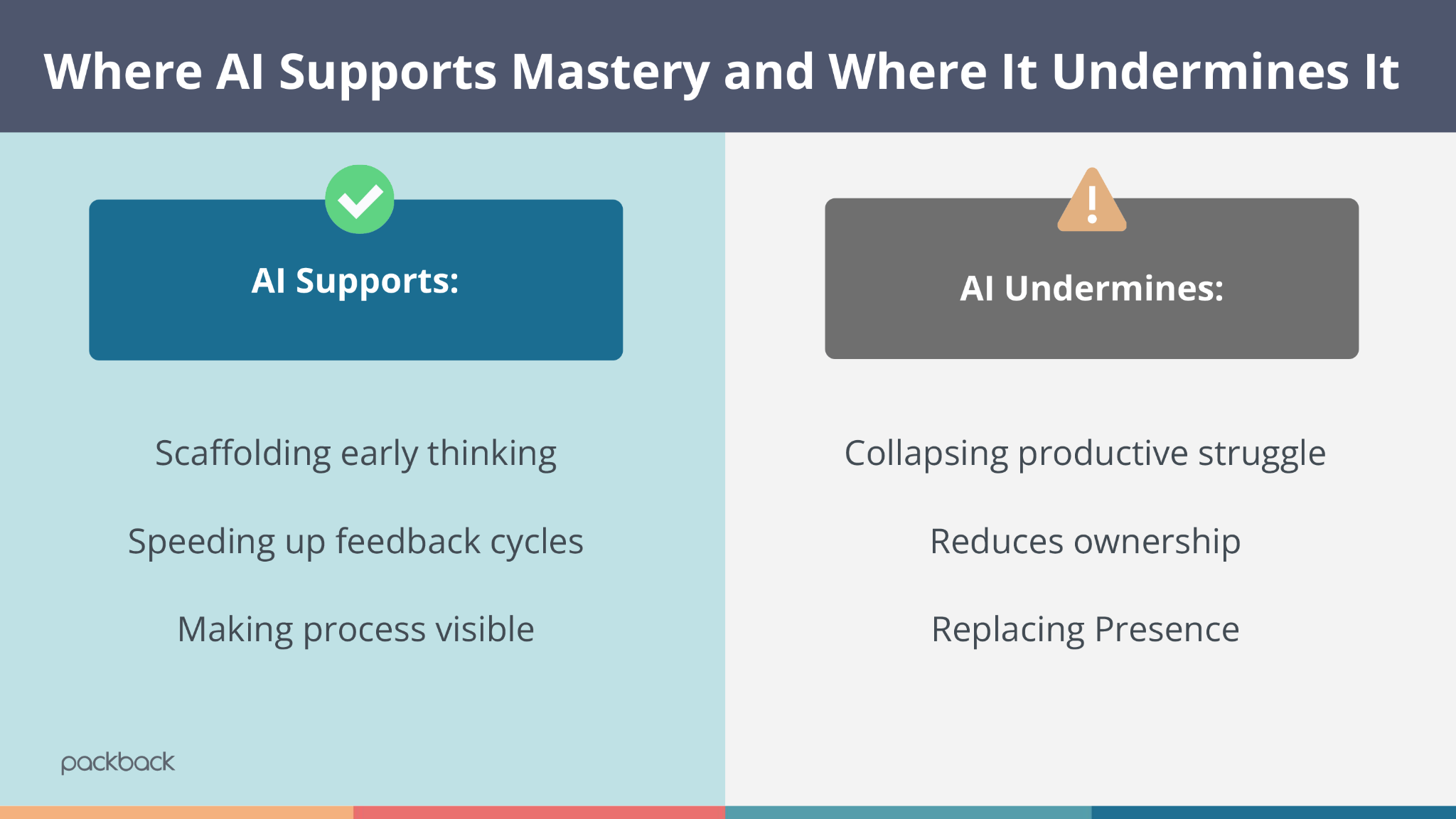
- AI Supports Mastery when it scaffolds early thinking, speeds up feedback cycles, and makes the learning process visible .
- AI Undermines Mastery when it collapses productive struggle, reduces student ownership, or replaces the instructor’s presence.
As Dr. Booth noted in a discussion regarding student self-regulation: “Productive friction beats frictionless completion.” Students need the “reps” of struggle to learn, and AI must be designed to surface thinking, not replace it.
See the Peer-Reviewed Study: How UNT Reduced Grading Time by 50% ›
An AI Evaluation Framework
To help educators navigate the saturated EdTech market, we shared a 6-point evaluation framework for selecting tools that actually move the needle:
- Drive Consistent Habits: Does the tool create sustained behaviors rather than one-off activities?
- Scaffold Deep Thinking: Does it push students to explain reasoning and use evidence?
- Foster Authentic Community: Does it help students feel like they belong to a learning group?
- Lower Instructor Friction: How much time will this realistically save the instructor each week?
- Align with Learning Science: Which evidence-based frameworks anchor the platform?
- Provide Actionable Data: Does this visibility help identify at-risk students earlier?
Ethical AI tools should amplify the mastery journey, not accelerate students past it. By focusing on behavioral design over simple delivery, institutions can ensure that AI strengthens the human side of learning.
How Can Teachers Use AI?
Technology is merely a “vehicle” for instruction. Just as a truck delivering groceries doesn’t cause a change in your nutrition, AI won’t cause learning unless the content and pedagogy are designed correctly. As we move forward, educators are shifting from “content deliverers” to Curators and Coaches who define the standards for mastery.

- For Planning and Feedback: Teachers can use AI tools to scaffold early thinking and speed up formative feedback cycles.
- To Normalizing Struggle: By building in revision and reassessment, teachers use AI to normalize mistakes as data rather than final failures.
- Designing for Productive Friction: AI should be used to surface thinking, forcing students to reflect and defend their logic rather than simply offloading the work to a “black box.”
Your Role Matters More Than Ever
Ethical AI tools should amplify the student’s journey. By focusing on behavioral design over simple content delivery, institutions can ensure that AI strengthens the human side of learning.