Bake AI Literacy Into Your Courses With These AI-Integrated Assignment Templates
Share this Article


Stop playing AI police. Learn how to implement process-based grading to make student thinking visible and download our free assignment design toolkit.
Generative AI broke the traditional grading model by proving that a polished final essay no longer guarantees actual learning occurred. You became an educator to inspire critical thinking and guide students through the messy, brilliant process of discovery. . . not to play AI police.
AI has fundamentally changed how college students write, research, and think. Naturally, it has to change how we assess them, too.
For a while, the knee-jerk reaction across higher education was to ban it or lean heavily on AI detection tools. But let’s be honest: you didn’t become a professor to play campus police. Trying to catch students using AI is exhausting, and worse, inaccurate AI detectors can trigger false accusations that severely erode student trust and campus culture.
We believe there is a much better, significantly less stressful way to navigate this. It requires a fundamental shift in how we view assignments: we need to stop analyzing the final artifact, and start instrumenting the process.
Combatting “Dead Education Theory”
When students use generative AI to bypass the “messy middle” of drafting and revising, they are experiencing cognitive surrender. Our goal is to redesign assignments to ensure AI acts as a scaffold for critical thinking, rather than a substitute for it.
Here is how modern educators are framing the difference to keep human thinking at the center of the classroom:
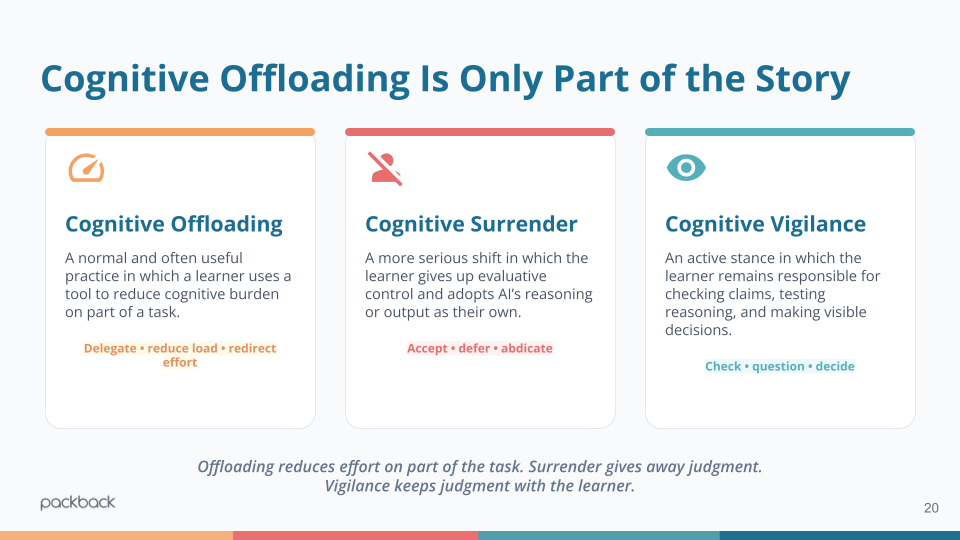
- Cognitive Offloading (Strategic Delegation): This is the act of delegating tasks to AI. When a student offloads a task, they are still retaining their critical thought. They are acting as a manager, using AI to outline, format, or check code, while maintaining total ownership of the ideas.
- Cognitive Surrender (The Failure State): This occurs when a student completely delegates their thinking and critical judgment to an AI tool. Instead of using the tool to aid their workflow, they remove their own judgment from the equation entirely. As one student noted in our recent survey, this phenomenon has “severely diminished the feeling I have of the work being ‘mine.’”
- Cognitive Vigilance (End Goal): The active, systematic scrutiny of AI output. It requires the student to verify reasoning, cross-reference sources, and provide a “misconception audit.”
The Pedagogical Shift to Making Thinking Visible
We believe curiosity always exists in the gap between not knowing and knowing.
To safeguard authentic learning in a world of generative AI, educators must shift from product-based assessment to process-based tracking. This means guiding students through outlining, drafting, revising, and citing, so that faculty can evaluate the actual learning process, not just the final outcome.
When students use AI to bypass the “messy middle” of drafting and revising, they experience cognitive surrender. Our goal as educators is to ensure AI acts as a scaffold for critical thinking, rather than a substitute for it. By tracking the process, we make authentic student effort visible, auditable, and grading-friendly.
What’s Inside the AI-Integrated Assignment Design Toolkit?
We know that faculty will only adopt new strategies if they save time, make writing assignments work at scale, and respect your autonomy in the classroom.
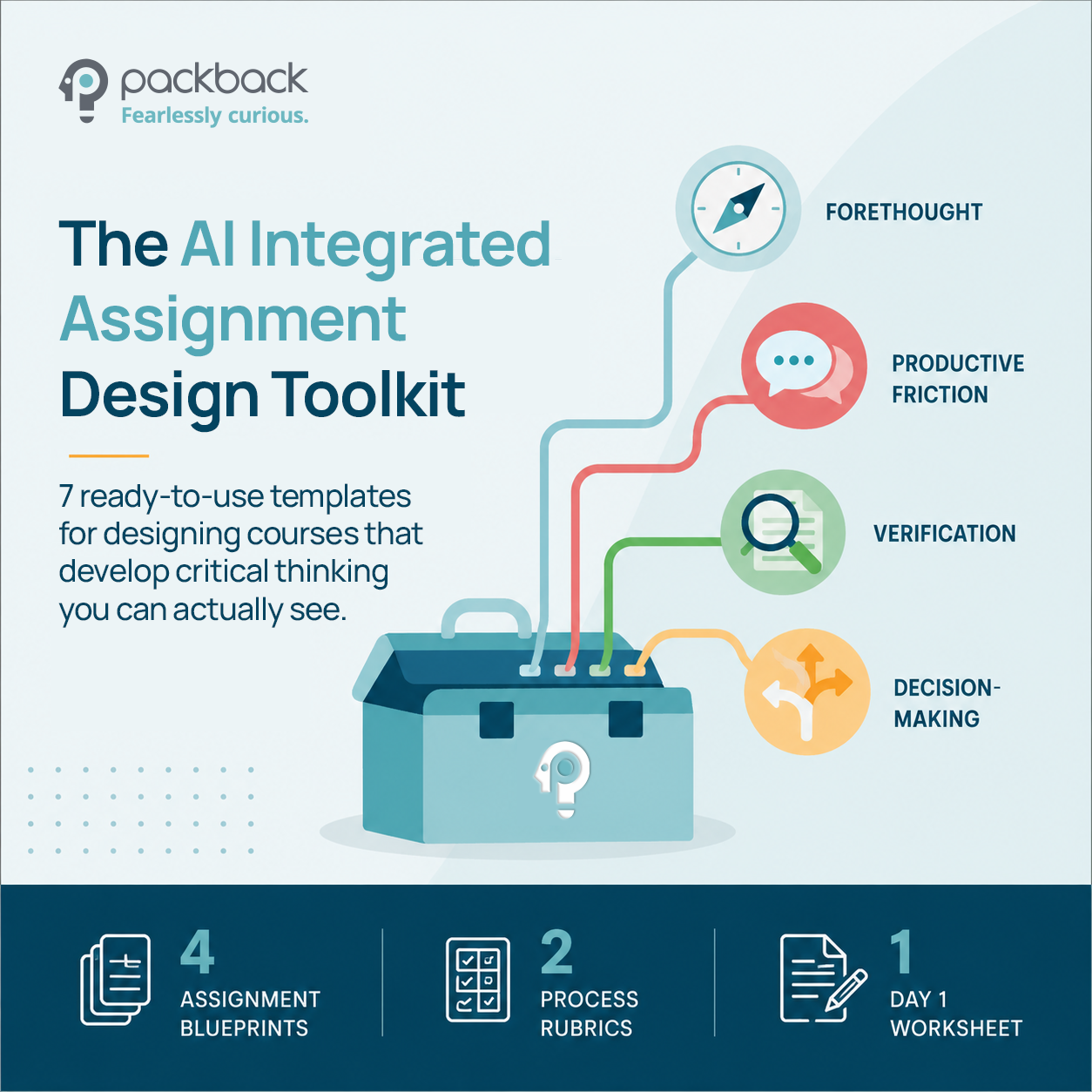
To help you seamlessly transition to process-based grading, we created a comprehensive, incredibly practical guide. The AI-Integrated Assignment Design Toolkit gives you the exact rubrics and frameworks you need to operationalize AI literacy.
Here is exactly what you can steal from this toolkit to use in your course today:
- Part 1: The Day 1 “Job Description” Goal-Setting Exercise
A week-one worksheet that disarms the “why do I have to learn this?” mindset by directly tying your course outcomes to your students’ future careers. - Part 2: The “Prompt Log” Rubric
A smart rubric framework that allows you to grade how effectively and critically students directed the AI, rather than just reading the AI’s output. - Part 3: The “Metacognitive Synthesis” Rubric
A tool to grade the student’s reflection on the AI’s performance, forcing them to critically evaluate, verify claims, and spot hallucinations.
- Part 3: The “Metacognitive Synthesis” Rubric
A tool to grade the student’s reflection on the AI’s performance, forcing them to critically evaluate, verify claims, and spot hallucinations. - Part 4: The Four AI Integrated Assignment Blueprints
Four classroom-ready, copy-paste assignments with targeted process rubrics designed to prevent cognitive offloading.- Blueprint 1: The “Forethought” blueprint (protecting the blank page): Requires students to establish their own thesis and intellectual intent before ever opening an AI chatbot.
- Blueprint 2: The “Friction” blueprint (Argument Lab): AI acts as a debate partner, forcing students to defend their reasoning against AI-generated counterarguments.
- Blueprint 3: The “Misconception Audit” blueprint (claim-source verification): Students audit AI-generated text against verified primary sources to catch hallucinations and nuance reductions.
- Blueprint 4: The “Decision Distance” blueprint (co-authorship log): Students maintain a detailed log of every AI suggestion they accepted, rejected, or transformed to restore and elevate their own voice.
Adopting these frameworks does not mean you have to start from scratch. By integrating these four parts into your existing syllabus, you create a learning environment where students are accountable for their intellectual choices. Instead of acting as an AI detective, you get to step back into your true role as a guide to fostering curiosity, evaluating the depth of their arguments, and actually enjoying the process of teaching again.
Recent Articles
-
Webinar Recap: How to Design College Assignments to Promote Critical Thinking & AI Literacy
-
Meet the AI Panic With Pedagogy, Not Policing and Why AI Detection Won’t Fix Academic Integrity
-
A Student Told Me They Were Ethically Opposed to AI. Here’s What I Wrote Back.
-
Make Student Thinking Visible in an AI World (Webinar Recap)