Introducing Packback Peer Review: Structured Feedback That Strengthens Student Writing
Share this Article

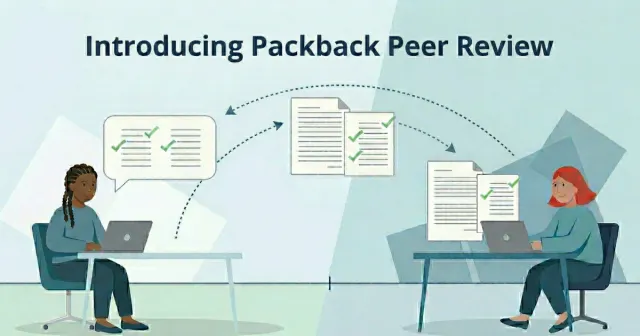
Coming early this Summer, Packback’s newest release, Peer Review, brings peer feedback directly into the writing workflow. Students review one another’s drafts, respond to structured prompts, and use what they learn to revise before final submission.
Writing improves through revision. But in many courses, revision is the first part of the writing process to get compressed, simplified, or skipped altogether. Largely due to the fact that meaningful revision takes structure, time, and coordination that can be hard to sustain across large classes, short terms, and already full teaching workloads.
That challenge becomes even more noticeable when peer review lives in disconnected tools or manual workflows. What should be a valuable part of the writing process can quickly turn into another administrative task to manage.
Coming early this Summer, Packback’s newest release, Peer Review, brings peer feedback directly into the writing workflow. Students review one another’s drafts, respond to structured prompts, and use what they learn to revise before final submission. Built into Packback Writing, Peer Review supports revision in a way that is structured, scalable, and scaffolded to how writing actually improves.
Why Peer Review Still Matters
When students read a peer’s draft, they are doing so much more than helping somebody else improve. They are also practicing the habits that make them better writers themselves by noticing what is clear or unclear, identifying gaps in reasoning, and thinking more carefully about audience, structure, and evidence.
Peer review also builds skills that extend beyond a single assignment. In many disciplines, the ability to give and receive feedback is part of professional practice. In addition to learning how to write, students in fields like nursing, business, public health, and education are also learning how to evaluate ideas, communicate clearly, and respond thoughtfully to critique.Peer review is crucial in helping students become more reflective readers, more intentional writers, and more capable collaborators.
Making Peer Review More Practical and Useful
Most instructors do not need to be convinced that peer review can be valuable. The harder question is whether it can be done in a way that is manageable and worthwhile.
In large gateway courses, short terms, and other high-volume teaching environments, peer review can quickly become difficult to coordinate. Manual matching breaks down, late work disrupts the process, and tracking who reviewed whom adds another layer of administrative work. Even when instructors do make space for peer review, students are not always prepared to give feedback that is specific or helpful. Too often, they are handed a blank comment box and left to figure it out themselves, which can lead to vague praise or surface-level edits that do little to improve the draft.
Packback’s Peer Review is designed to address both challenges. It supports automatic student matching and completion-based grading, making the logistics easier to manage, while also giving students structured prompts that help make feedback more consistent, constructive, and useful. Instead of treating peer review as a disconnected step, it brings drafting, feedback, and revision into one workflow inside Packback Writing.
That matters because students often receive the most useful feedback at the very end of the writing process, when there is little chance to apply it. By moving structured peer feedback earlier, while ideas are still taking shape, Peer Review helps students revise more intentionally and helps instructors see stronger drafts before final grading begins. It also makes Peer Review a natural complement to the rest of the Packback platform, extending our writing workflow with another meaningful layer of formative feedback.
A Better Way to Bring Revision into the Writing Process
Packback Peer Review helps make one of the most valuable parts of writing instruction easier to run and more useful for everyone involved. It helps students think more critically, revise more intentionally, and engage more fully in the writing process. Packback’s Peer Review is designed to make that process more practical to implement at scale, with the structure and support needed to make peer feedback more consistent, constructive, and actionable.
Recent Articles
-
What Good AI Assignment Design Looks Like, and Why We Built Teach the AI First
-
Webinar Recap: How to Design College Assignments to Promote Critical Thinking & AI Literacy
-
Meet the AI Panic With Pedagogy, Not Policing and Why AI Detection Won’t Fix Academic Integrity
-
A Student Told Me They Were Ethically Opposed to AI. Here’s What I Wrote Back.