Why Peer Review Belongs in the Future of Writing Instruction
Share this Article

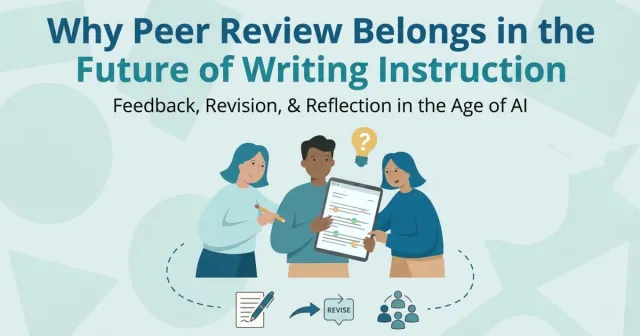
Peer review has always been one of the most powerful ways to help students see writing as a process, not just a final product. In the age of AI, it matters even more because it makes thinking, revision, and feedback visible, helping students build judgment rather than simply produce polished work.
Writing Has Always Been a Process, Not Just a Product
Peer review is hardly new. In writing classrooms, workshop models, and professional settings, it has long played a role in helping people refine their thinking through feedback, revision, and exchange. But in this moment in education where instructors are navigating student disengagement, larger class sizes, changing landscapes in education, and the growing presence of generative AI, peer review feels newly important. Not because it is novel, but because it embraces the fact that writing is a process and learning is social.
Too often, writing assignments are solely focused on the final product. A paper is assigned, submitted, and graded. In this formulation, what disappears from view are the decisions and discoveries that shape the work along the way: planning, drafting, questioning, revising, responding to feedback, and clarifying ideas for an audience. Process writing has long pushed against that narrow view. Emerging in the 1970s and becoming more widely adopted in the 1980s, process-oriented approaches to writing shifted attention away from the finished artifact alone and toward how students write, how they make decisions, and how they improve over time. As I’ve come to think about it, it treats writing as an activity that, through effective communication, demonstrates knowledge, and it seeks to scaffold that activity such that we better facilitate and validate conscious learning within a student. In essence, the writing is the learning.
Why Process Writing Matters More in the Age of AI
The four stages of competence is a psychological learning model that maps a student’s journey from incompetence to competence, and locates their level of self-awareness and resulting fluctuation of self-assuredness along the way. Crucially, this model tells us that when students have a nascent or developing grasp on something and begin to demonstrate their understanding through conscious acts like writing, their confidence can sharply decline. It is in these moments where cognitive offloading is most tempting, where they are most likely to use a shortcut.
In an environment shaped by generative AI, polished output has become easier to produce. But the appearance of fluency is not the same thing as learning. If educators focus only on the final submission, they risk missing the thinking behind it, or the absence of that thinking. Process writing deserves renewed attention because it meets each student where they are at and offers support as their knowledge and ideas mature through writing. It makes room for formative steps, visible development, and the kinds of interactions that help students build judgment rather than simply produce text.
As AI tools become more common in academic life, institutions are being pushed to decide what they most value in student work, the product or the learning. If they want students who can reflect, revise, collaborate, and think critically, they must incorporate process writing strategies into their methods. Peer review, in its social and metacognitive modes, is among the most powerful of these strategies.
How Peer Review Improves Student Writing
What makes peer review so valuable is that its benefits extend beyond the student receiving comments. The student doing the reviewing is also practicing a set of essential intellectual moves like reading for intention, analyzing structure and argument, identifying gaps, offering actionable suggestions, and considering the audience. These are writing skills, but they are also thinking skills. They require students to move beyond reaction and into evaluation. They ask students to articulate why a piece of writing is or is not working and what might strengthen it. In turn, these evaluative skills lead to self-reflection as students begin to see their own writing in a new light.
This is part of why peer review has such enduring value in higher education. When process is de-emphasized and learning is validated strictly through a teacher-student hierarchy, writing can cease to be an act of curiosity or discovery and instead stifles under the binary of right and wrong. Peer review demonstrates to students that writing is not a one-way act of production, but a dynamic process of making meaning, responding to readers, and improving through revision. When students participate in peer review, they not only deepen their own understanding of what strong writing requires, they adjust how they validate and construct that understanding. They orient themselves toward a community of equals where values are decided together.
Peer Review Builds More Than Writing Skills
The broader pedagogical point here is that learning is social. Students do not develop knowledge in isolation, but rather they clarify their ideas by encountering other perspectives, negotiating meaning, and trying to communicate something clearly enough that another person can engage with it. Peer review is powerful because it embraces the social dimension of learning and creates a context in which students are not only writing for a grade, but writing to be read, questioned, and understood.
This is one reason I think we should be more careful with the way we talk about so-called “soft skills.” Communication, collaboration, critical thinking, and social awareness are often treated as secondary competencies, but they are not secondary at all. They are core skills. In fact, they may be becoming more important as AI tools grow more capable. If students and professionals can outsource surface-level production more easily, then the human skills that matter most are the ones tied to judgment, interpretation, responsiveness, and collaboration. Peer review creates opportunities to practice exactly those skills.
Why Higher Ed Institutions Should Care About Peer Review
For institutions, this matters for practical reasons as well as pedagogical ones. Many instructors want to assign writing because writing remains one of the most effective ways to help students demonstrate thought, synthesize knowledge, and build durable skills. But wanting to assign writing and being able to support it well are not the same thing. Faculty are teaching larger classes and some are working with fewer resources. Others may value writing but do not see themselves as writing specialists. The challenge, then, is creating realistic ways for them to support meaningful writing without turning every assignment into an unsustainable workload.
This is where peer review can be especially useful; it provides educators with a student-driven formative step within the writing process. It gives students more opportunities to reflect and revise before final submission, and it helps instructors create meaningful checkpoints without carrying the full burden of every stage of feedback alone.
How Packback Thinks About Peer Review
Over the past few years, Packback has deepened its commitment to surfacing the writing process itself through features like our real-time feedback, Originality Fingerprint, revision & follow-up assignment features, and Engagement Insights. Peer review is a continuation of that investment and marks, along with our upcoming addition of team work assignments, a turn toward the social processes of writing. It is instructor-guided, but student-driven. Students do the work of reading, responding, and revising. Instructors remain essential, but they are better positioned to focus on what students are actually trying to say and what they have learned, rather than spending all of their time correcting writing that is still half-formed.
This matters especially now, when institutions are trying to balance rigor, authenticity, faculty workload, and responsible AI use all at once. Peer review does not solve every challenge in writing instruction. But it does reinforce something essential: students learn more when writing is treated as an iterative, visible, and social process.
The Future of Writing Instruction Is More Visible, Social, and Iterative
What I hope institutions understand is that choosing to incorporate peer review is bigger than a workflow decision. It is a statement about what we think writing instruction should value. It says we see writing as learning, and we support that learning from the moment knowledge is acquired and throughout the process by which it matures into understanding. It says that students develop core skills socially, and that a community of peers is one of the most valuable things an institution has to offer. Packback’s approach to peer review proves that adopting a process writing approach doesn’t have to be burdensome for an instructor. In combination with automated real-time feedback, the writing process report, culminating follow-up assignments, and more, instructors can facilitate deeper, scaffolded learning through a streamlined, guided writing journey.
About the Author

Recent Articles
-
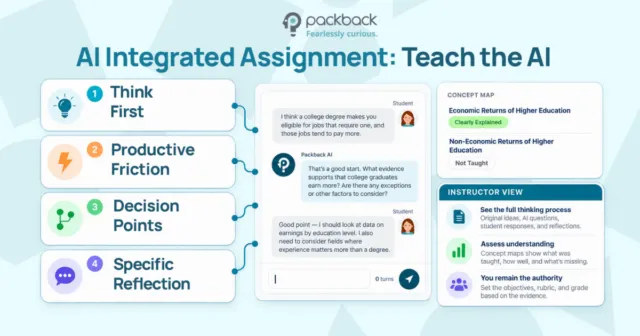
What Good AI Assignment Design Looks Like, and Why We Built Teach the AI First
-
Webinar Recap: How to Design College Assignments to Promote Critical Thinking & AI Literacy
-
Meet the AI Panic With Pedagogy, Not Policing and Why AI Detection Won’t Fix Academic Integrity
-
A Student Told Me They Were Ethically Opposed to AI. Here’s What I Wrote Back.