Visible Thinking is the New Standard for Institutional Academic Integrity
Share this Article

AI policy is a moving target, but retention shouldn’t be. Here is why shifting from policing outputs to valuing the “Visible Thinking” process is a fiscal imperative
Provosts are facing a “triple threat:” an impending enrollment cliff, intense budget scrutiny, and AI-induced campus controversy. In this high-stakes environment, every institutional budget line item must prove a quantifiable link to enrollment stability.
We recently explored these challenges in our latest webinar, “What Student Engagement Looks Like in the Age of AI,” co-hosted with Dr. Cynthia Wilson from the League for Innovation in the Community College. Dr. Wilson provided an illuminating lens, arguing that community colleges serve as “laboratories” for innovation. The goal of these institutions, she notes, has never been just academic compliance; it is student success, persistence, and degree completion.
Here is why your institutional AI strategy should stop leading with “academic integrity policing” and start leading with “student persistence data.”
1. How does student engagement impact retention?
For a Provost, “engagement” cannot just be a philosophical “nice-to-have” concept. It is the core financial engine of the university.
Research by Kuh et al. (2008) in their seminal study, “Unmasking the Effects of Student Engagement,” provides the specific ROI data. Their analysis found that a standard deviation increase in student engagement is associated with a 17% increase in the odds that a student will return for their second year.
2. What is Kuh et al.’s research on student engagement and retention?
The significance of the Kuh et al. data lies in its universality. They discovered that engagement has a compensatory effect. It provides the largest retention lift for at-risk, first-generation, and historically underserved students.
The research is clear: the productive struggle of “Show Your Work” is a survival mechanism. Students who are actively developing their own ideas are more likely to navigate academic adversity, feel a sense of belonging, and persist. By cultivating deep, visible engagement, institutions can directly maintain enrollment levels and provide a clear ROI on academic spending.
3. How to improve student retention by solving the “Invisible Learning” crisis?
If engagement is the goal, the entire institutional ecosystem must be aligned to measure it. As Oliver Short, Packback’s Senior Director of Product, highlighted: “Engagement is an outcome, it’s not an output.”
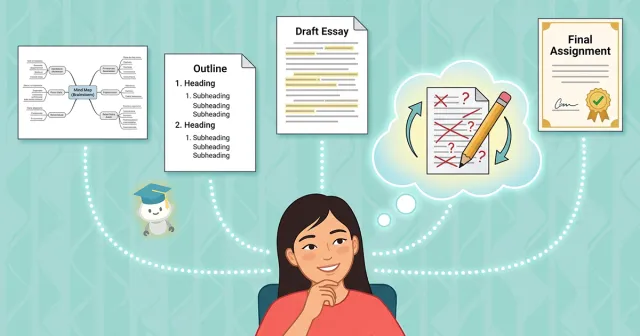
The problem is that the learning journey is usually invisible. The final essay represents only the 10% of learning that occurs above the surface. Traditional methods only evaluate this finished document. This leaves faculty unable to identify students who are struggling to outline, draft, or process feedback before they disengage and drop out. By instrumenting the writing process, institutions can make the invisible journey visible.
4. How to mitigate the governance risk of “Black Box” detection?
When institutions lead AI strategy with detection, they increase governance risk. Faculty resist policing mandates, and students are terrified of false “gotcha” accusations, especially when the detection is based on “black box” algorithms.
This erosion of trust is why a shift in narrative is required. During our live session, we polled hundreds of educators. 38% of your peers now identify that “verifying the process” is the most important part of their role. These are not faculty looking to catch cheaters; they are instructors who realize they can no longer measure student progress without visibility into the learning journey. Packback provides that lens, giving instructors the data to assess authentic human effort without mandating a specific teaching style.
Recent Articles
-
Webinar Recap: How to Design College Assignments to Promote Critical Thinking & AI Literacy
-
Meet the AI Panic With Pedagogy, Not Policing and Why AI Detection Won’t Fix Academic Integrity
-
A Student Told Me They Were Ethically Opposed to AI. Here’s What I Wrote Back.
-
Make Student Thinking Visible in an AI World (Webinar Recap)