Make Student Thinking Visible in an AI World (Webinar Recap)
Share this Article

We asked over 200 faculty and academic leaders how they know a submission reflects a student’s own thinking. Only 7% named AI detection. Here is the 5-minute recap of what they use instead.
Last week we got together with Dr. Cynthia Wilson and our friends at the League for Innovation in the Community College for a conversation we’ve been circling all year: When AI can produce the essay, how does anyone actually know a student thought their way through it? Over 200 educators across 70 institutions joined us live as we arrived at the same consensus that post-submission detection is no longer the answer… and hasn’t been for a while.
Keep reading for the top five takeaways and then watch the full session on demand, which now includes a complete round-up of the 14 best ideas attendees shared in the chat. Here is the five-minute version.
Only 7% of educators still rely on AI detection tools to verify original thinking.
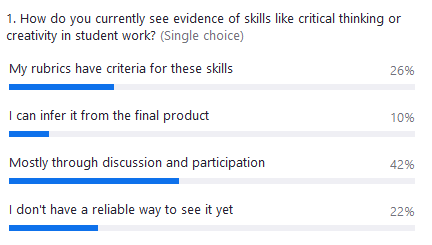
In a live poll of over 200 attendees, only 7% said AI detection tools are how they know a submission reflects a student’s own thinking. The most common answer, at 33%, was that they ask students to explain their choices.
Clearly, detection has long since left the room.
Policing the final academic artifact is exhausting, demoralizing, and fundamentally unwinnable. As one faculty chair noted, the current landscape feels like playing Whack-a-Mole with AI detection, where hitting one issue just causes three more to pop up. The era of post-submission detection is failing educators and disproportionately punishing vulnerable students.
Building on the shared sentiments in the chat, Oliver Short, Senior Director of Product and Design at Packback, made the case that detection cannot carry the weight institutions have been putting on it as a proxy for learning. The thinking may still be happening, but measuring it reliably is the part that broke.
He compared it to throwing a dart at a dartboard while the dartboard rides past on a speedboat. Why? Model providers roughly double in capability every six months, and they have enormous incentive to sound more human.
They will fix the em dash tell.
They will fix the rule of threes.
The only open question is when.
The equity math makes it worse. Research by Liang et al. found that 61% of essays written by non-native English speakers were falsely flagged as AI generated. Detection-first policies land hardest on first-generation students, multilingual learners, and non-traditional students. Vanderbilt disabled Turnitin’s AI detector for related reasons. When a tool misfires, it misfires hardest non-traditional students who have the least room to absorb an accusation.
5 Ways Educators Are Making Student Thinking Visible
Attendees packed the chat with dozens of field-tested strategies from community college and university educators fighting to preserve authentic learning. These were our favorite highly practical strategies from over 200 educators:
- A Misconception Audit: Provide students with four AI-generated pieces of media and require them to check each against a reliable source, grading their fact-checking process rather than a newly written essay.
- The Rationale Paragraph: Ask students to write a short paragraph beside any AI-assisted draft detailing what they changed, why they changed it, and what they kept despite AI suggestions.
- Knowledge Check Interviews: Replace traditional discussion monitoring with oral exams or brief video conferencing interviews to verify learning directly and get to know students better.
- First-Day Baselines: Utilize low-stakes introductory emails to the TA or first-day goal-setting exercises to establish a reliable baseline of the student’s authentic writing voice.
- Peer Review Before AI: Sequence assignments so human peer feedback is officially on the record before students are permitted to bring AI into the drafting phase.
Mapping Essential Learning Skills & Their AI Literacy Partners
You can organized this pedagogical shift around four capabilities and one question each that pulls the thinking into the open. The framework starts from skills you already assess: critical thinking, communication, collaboration, and creativity. Nothing gets added to your outcomes. Each skill picks up an AI-era partner:
- Critical thinking becomes judgment. Can your students tell when AI is wrong, shallow, or has a structural bias?
Ask: which claim did you almost accept, and what made you stop? - Communication becomes explanation. Can they defend what they changed and what they kept? Ask: where did your argument change while you were writing, and what changed it?
- Collaboration becomes coordination. Can they work with peers first and treat AI as one teammate rather than a substitute for the team?
Ask: whose feedback changed your contribution, and how? - Creativity becomes agency. Can they generate their own ideas and say why they picked one?
Ask: what did you decide not to do, and why?
The through-line is metacognitive reflection. Students who pause to notice their own thinking pull more out of the same assignment, and reflection is the one move AI cannot make on a student’s behalf. That shift has a name we use internally: moving students from cognitive surrender, where they accept the output, to cognitive vigilance, where they interrogate it.
Breaking the “Dead Education” Loop
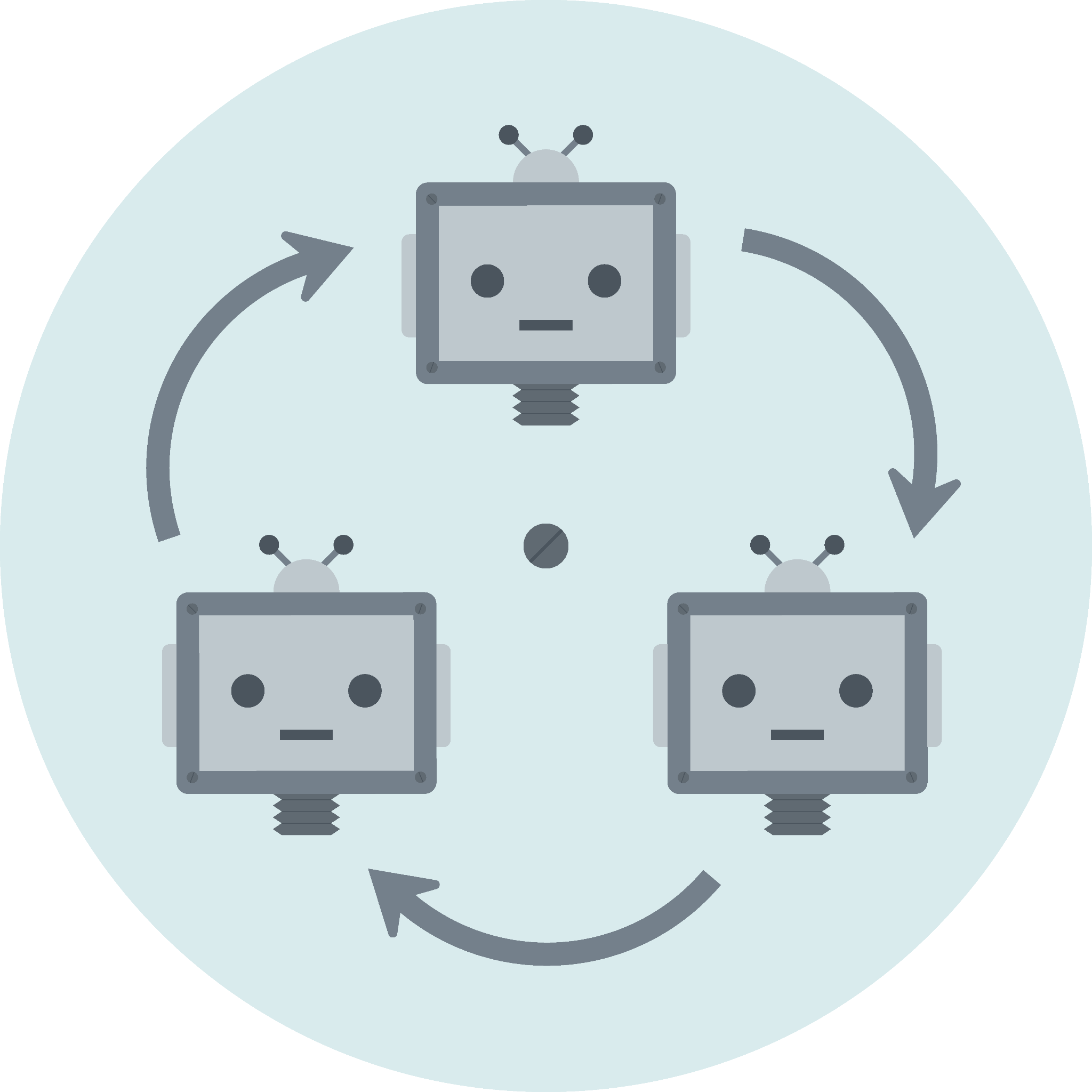
It goes without saying that this pedagogical shift is overwhelming and all-encompassing. In fact, 53% of educators in our session cited a lack of time to redesign assignments as their biggest barrier to change. One attendee voiced the existential dread many are feeling, questioning why we are even here if a machine is just generating homework for another machine to grade?
This closed loop of AI submitting to AI is known as “Dead Education Theory.” The solution to this validity crisis isn’t to ban technology or retreat entirely to blue-book exams (which scarcely work anyway). What we must do instead is to leverage learning intelligence platforms for higher ed that seamlessly instrument the writing process itself.
By validating the steps between claim and conclusion – the messy middle where true learning happens – we can rebalance human connection and digital innovation.
The Messy Middle & Grading the Climb
In the past, submitting a polished essay was like showing a photo of yourself standing at the top of a mountain summit. Educators could safely assume that to get that photo, the student put on hiking boots, trudged up the trails, decided when to stop for camp, and generally worked through the struggles of putting in the physical effort.
Today, generative AI is a helicopter. A student can take a 30-second ride to the top, snap the exact same summit photo, and hand it in. Standing at the peak is no longer proof of the effort.
So look at the climb instead. As Kelsey Behringer, Packback CEO put it:
“The summit photo looks the same whether the student climbed to the top of the mountain or took a gondola. Grade the climb along the way, not the photo at the end.”
For students, learning lives in the climb: the planning, the drafts, the revisions, the moments a student notices their own thinking. The photo at the top proves nothing about how anyone got there.
For educators, every stop on the path leaves something you can actually see.
- Planning leaves a direction the student chose over other directions.
- Drafting leaves a sequence.
- Revising leaves a change and a reason for it.
- Reflecting leaves an account of what shifted.
But it has to work at scale. A DIY system that works beautifully for a seminar of 18 can easily disappear in a 275-student asynchronous section. So the real question is no longer detection versus no detection. It is visibility at a size one human can actually carry. That’s what we’ll unpack during our September session. Hope to see you there!
Recent Articles
-
Webinar Recap: How to Design College Assignments to Promote Critical Thinking & AI Literacy
-
Meet the AI Panic With Pedagogy, Not Policing and Why AI Detection Won’t Fix Academic Integrity
-
A Student Told Me They Were Ethically Opposed to AI. Here’s What I Wrote Back.
-
AI Assignment Design That Makes Student Thinking Visible (and Gradeable)