Webinar Recap: How Student Engagement Fuels Outcomes and Institutional Growth
Share this Article

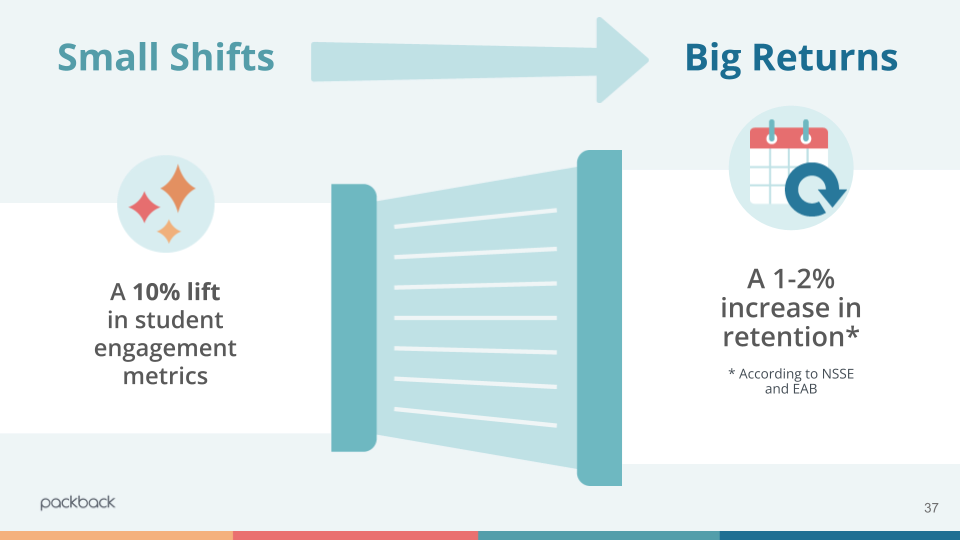
A 10% lift in student engagement can drive a 1–2% increase in retention. See how the Community of Inquiry framework connects classroom engagement directly to institutional growth.
We know student engagement is critical. But how do we translate that belief into a reliable strategy for institutional growth? In an era of competing priorities, AI disruption, and the relentless pressure to improve retention, leaders need a clear, evidence-based roadmap that connects classroom-level effort to bottom-line results.
Our latest webinar, “The Engagement Equation: How Student Engagement Fuels Outcomes and Institutional Growth,” featuring Packback’s Chief Technology Officer, Dr. Craig Booth, cuts through the noise to provide just that. For a deep dive into the data and frameworks that work, watch the full on-demand recording here.
The Real Challenges Facing Today’s Institutions
Instead of starting with hypotheticals, we went straight to the source, asking leaders in the audience to name the biggest challenge facing their institution right now. The responses, shared live in the chat, painted a clear picture of the pressures in modern education:
- Competing priorities for students’ time and attention.
- Concerns over unmitigated AI use.
- The foundational challenge of student retention.
- Reluctance to engage socially in online environments.
- Finding ways to engage non-traditional students, like dual-credit high schoolers.
We already know these are not isolated issues, but are interconnected facets of a single, core challenge: creating an educational experience so compelling that students choose to persist.
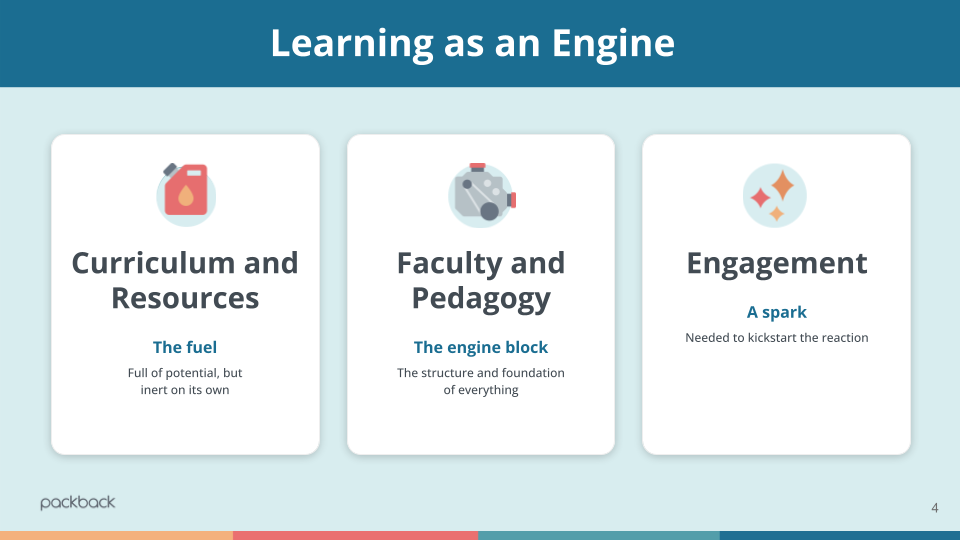
Dr. Booth framed the solution using a powerful metaphor: If curriculum is the fuel and faculty are the engine, then meaningful engagement is the spark. Without that spark, even the most well-designed course remains inert, full of potential but going nowhere.
Beyond Compliance: The Framework for Authentic Engagement
The session drove home a critical point: not all engagement is created equal. Mandated discussion posts or simple click-through activities often result in what we’re calling “mechanical compliance,” not the deep cognitive effort that leads to learning and a powerful sense of belonging.
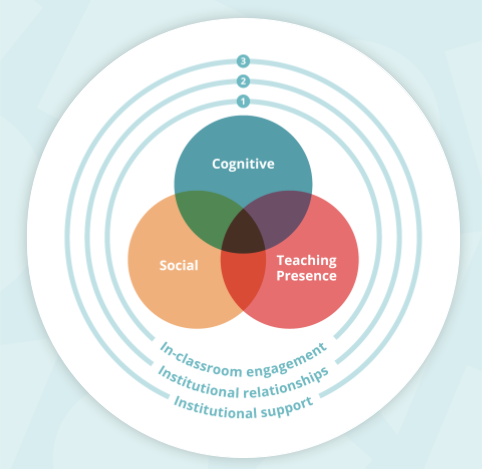
So, what actually works? Dr. Booth explained the Community of Inquiry (CoI) model, a decades-old, research-validated framework that identifies the three essential, overlapping pillars of a successful learning environment:
Teaching Presence: This is the instructor’s role in designing, guiding, and facilitating the learning experience. It’s how students know the course is intentionally structured for their success.
Social Presence: This is the feeling of belonging. It’s the ability for students to connect with peers, feel seen as individuals, and build the relationships that are crucial for persistence.
Cognitive Presence: This is the “a-ha!” moment. It’s the extent to which learners are challenged to move beyond memorization and actively construct meaning through sustained reflection and discourse.
“When these three things are present, you have a community of inquiry. And when you have that, you have a really powerful, really durable learning experience… the kind of experience that keeps students around.” – Dr. Craig Booth
From Classroom to ROI
The most powerful part of the webinar was the direct line drawn between this pedagogical framework and the financial health of an institution. Improving engagement isn’t just a “nice-to-have”; it is a strategic lever with a clear and predictable return on investment.
Citing extensive research from sources like the National Survey of Student Engagement (NSSE), Dr. Booth demonstrated that a modest 10% lift in key engagement metrics can lead to a 1-2% increase in student retention.
What does that mean in real numbers?
For a mid-size institution of 4,000 students, a 1.5% retention gain translates to 60 retained students and an estimated $450,000 in revenue.
For a larger institution of 15,000 students, that same 1.5% gain results in 225 retained students and over $1.4 million in revenue.
This is the “Engagement Equation” in action. Targeted, pedagogically-sound improvements in the classroom create a ripple effect, leading to significant, institution-wide financial stability and growth. That success creates a virtuous cycle, freeing up more resources to reinvest in the student experience.
This recap only scratches the surface.
The full, on-demand webinar provides a much deeper dive into the evidence, including a six-point checklist for evaluating whether an EdTech tool is truly built to drive the behaviors that matter for retention and success.
Recent Articles
-
Webinar Recap: How to Design College Assignments to Promote Critical Thinking & AI Literacy
-
Meet the AI Panic With Pedagogy, Not Policing and Why AI Detection Won’t Fix Academic Integrity
-
A Student Told Me They Were Ethically Opposed to AI. Here’s What I Wrote Back.
-
Make Student Thinking Visible in an AI World (Webinar Recap)