AI Assignment Design That Makes Student Thinking Visible (and Gradeable)
Share this Article


What if the secret to handling AI in higher education isn’t catching students in the act, but coaching them in the middle of thinking? It is time to move past the endless game of AI detection and turn student AI collaboration into visible, gradable evidence of learning.
If you have spent the last few semesters tweaking prompts, adding lockdown browsers, or rebuilding rubrics to stay one step ahead of generative AI, you are probably exhausted.
Educators everywhere have tried oral defenses, in-class blue books, “AI-proof” prompts, and required reflection addendums. Some have quietly stopped assigning papers altogether. Every time an assignment gets AI-proofed, another model update rolls out and the cycle repeats.
A better use of that energy is AI assignment design. Instead of building assignments AI cannot touch, build assignments that require students to evaluate what AI produces, and capture every decision they make along the way. We don’t need to catch students. We need to make thinking visible.
How do you track the student writing process instead of using AI detectors?
First, we need to adopt a “show your work” philosophy which means moving from detection to instead focus on decision-making.

AI Integrated Assignments are structured, LMS-native activities where students evaluate, verify, revise, and challenge AI output instead of passively accepting it. By capturing every decision a student makes during their interaction with AI, these assignments convert hidden reasoning into a clear, gradable trail of authentic student effort.
Once we accept that students are already using AI, the core question changes. It is no longer about access (“Are they using AI?”), but about skill (“Are they building the judgment to use it well, and can you see it?”).
When a student uses AI in secret, the entire learning process becomes a black box. You only see a polished final draft, leaving you to guess where the student’s thinking ends and the software begins. Unreliable detection tools only make things worse, creating an adversarial classroom dynamic and risking false accusations that break student trust.
How can professors integrate AI into assignments without cheating?
AI Integrated Assignments flip this dynamic completely. By embedding AI directly into the assignment workflow, student reasoning, decisions, and revisions are captured automatically. Instead of evaluating an isolated final product, you get a front-row seat to the student’s actual learning journey.
The Four-Step Spine Behind Better AI Assignment Design
Every assignment type built on this framework follows a clear, intentional design built around four steps that protect original human thought while building critical AI literacy:
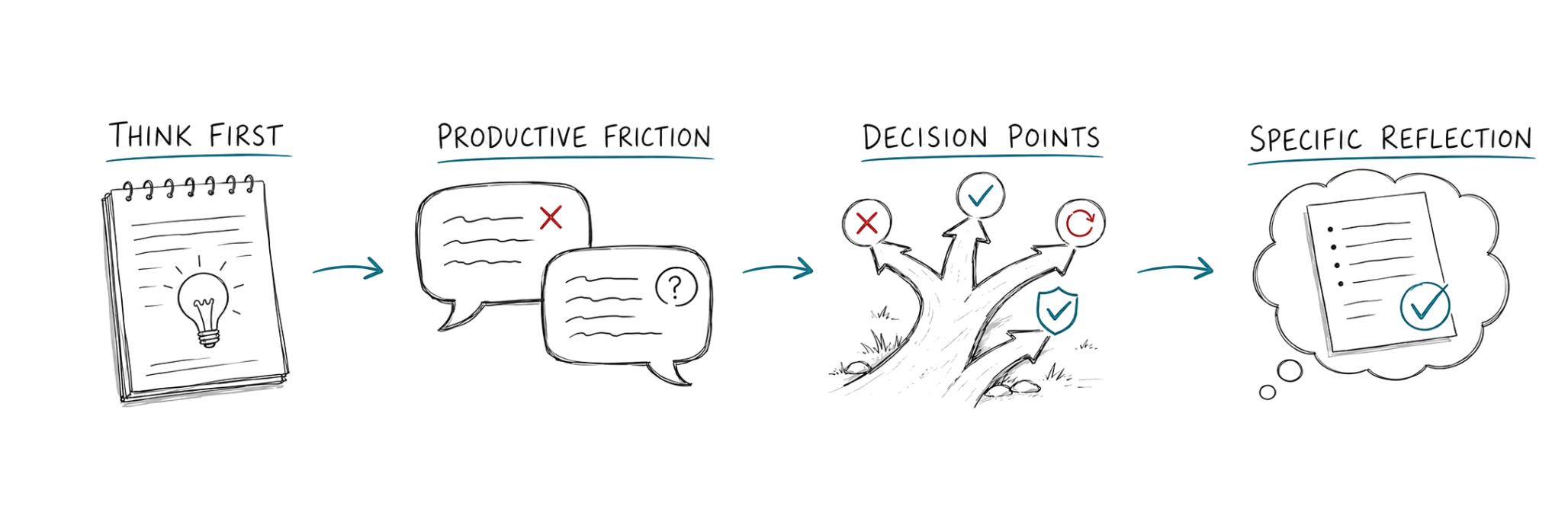
- Think First: Before touching an AI tool, students commit to a position or write down an initial plan. This gives instructors a baseline of what the student brought to the task before any assistance enters the picture.
- Productive Friction: Rather than giving quick answers, the AI introduces deliberate cognitive challenges that push back on weak arguments, ask clarifying questions, or present deliberate errors for the student to find.
- Decision Points: As students navigate the task, every choice is logged. The student acts as the senior editor who accepts, rejects, revises, or verifies output. This builds cognitive vigilance, ensuring students direct the technology rather than surrendering to it.
- Specific Reflection: Students close the assignment by accounting for concrete choices: why they rejected a specific suggestion, how a counterargument shifted their view, or how they verified a questionable claim.
Three Categories of Assignments Built for Real Thinking
Depending on your discipline and learning objectives, AI Integrated Assignments target specific skills across three main categories:
1. Conversational Reasoning
In Teach the AI, students explain a complex concept to a “novice” AI that asks questions, misinterprets shallow explanations, and pushes for clarity. You walk away with a concept map showing exactly where the class gets stuck before you even walk into lecture. In Argument Lab, students lock in a thesis and defend it against AI counterarguments aimed directly at their specific claims. Weak arguments surface at word 200 rather than word 2,000.
2. Close Reading & Analysis
In Claim–Source Verification, the system presents AI-generated claims about an instructor-chosen source text. Students must mark each claim as accurate, misleading, or false, and attach direct proof from the text. It solves the critical reading collapse by making evidence-based evaluation the central task.
3. Co-Writing with AI
In the Co-Authored Essay, students plan their piece, then accept, rewrite, or reject AI suggestions paragraph by paragraph. That decision record turns in alongside the final draft, giving you full visibility into their editing and direction.
By assuming AI is in the room and building assignments where student judgment is the work, we can stop playing catch-up and start inspiring authentic, fearless curiosity again.
Recent Articles
-
Webinar Recap: How to Design College Assignments to Promote Critical Thinking & AI Literacy
-
Meet the AI Panic With Pedagogy, Not Policing and Why AI Detection Won’t Fix Academic Integrity
-
A Student Told Me They Were Ethically Opposed to AI. Here’s What I Wrote Back.
-
Make Student Thinking Visible in an AI World (Webinar Recap)